The Cross-Cultural Leadership Compass: A Practical Guide to Its 11 Leadership Dimensions
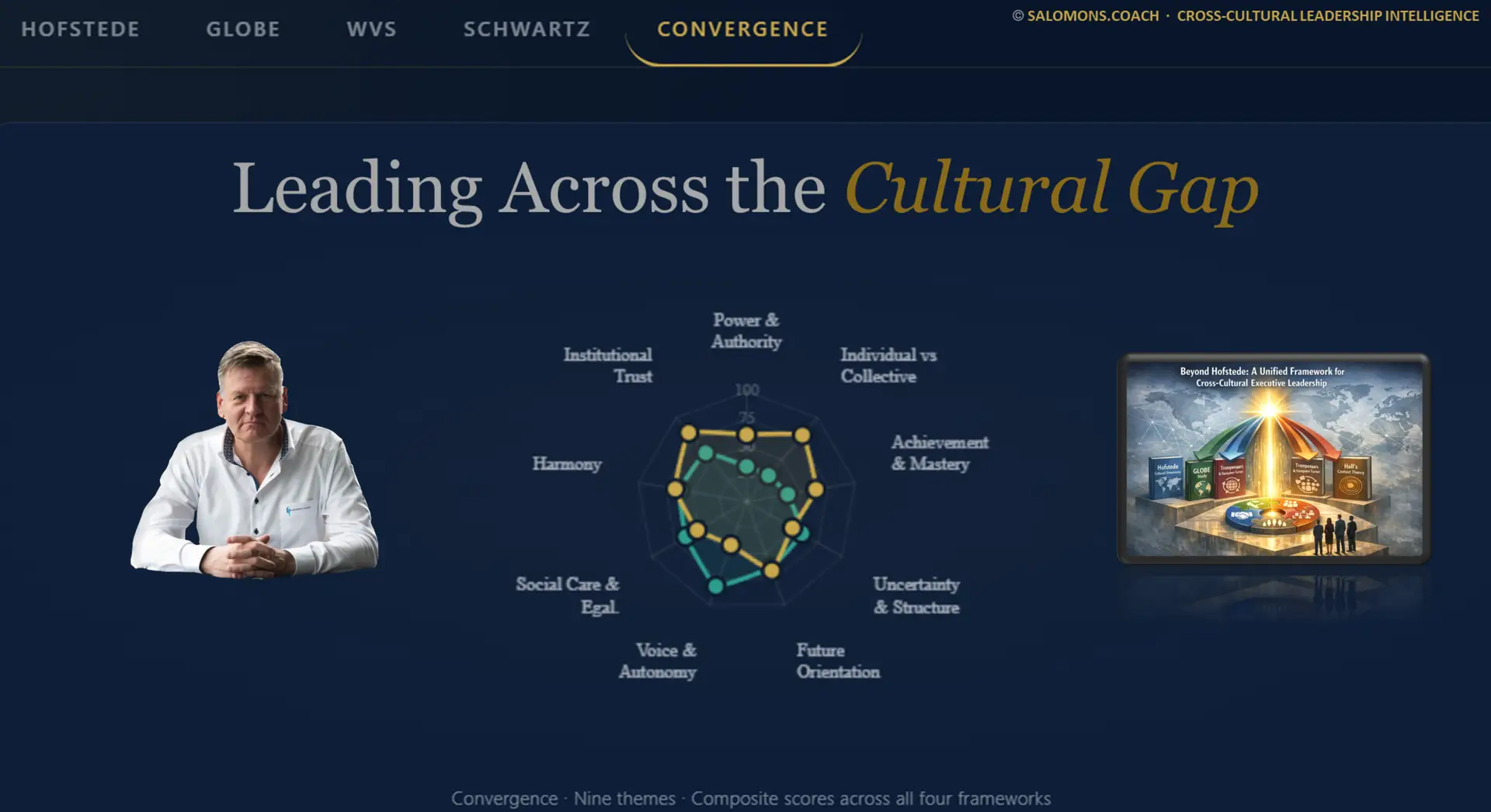
How a four-framework cultural analysis translates into real leadership behavior — dimension by dimension
Every leader who crosses a cultural boundary carries two operating systems at once. One was installed in childhood. The other was acquired through years of professional adaptation. The real skill, the one that separates effective cross-cultural leaders from merely well-travelled ones, is knowing which system is running at any given moment, and whether it is serving the situation.
The Cross-Cultural Leadership Compass, developed by Salomons.Coach, is built around exactly this challenge. It is not a personality test. It is not a cultural tourism guide. It is a structured analytical tool that maps the structural distance between two national professional cultures across four independently validated academic frameworks: Hofstede, GLOBE, the World Values Survey, and Schwartz, and translates that data into eleven specific leadership dimensions where the cultural gap plays out in practice.
This post unpacks what those eleven dimensions are, why they matter, and how to read them usefully.
Note: The information in this post explains the eleven leadership dimensions, that you can find in the detailed full report. This report is not for free and can be downloaded, after completing 5 short questions, for a fixed and very reasonable price, given the unique insights and amount of ionformation provided.
First: What the Compass Actually Measures
Before diving into the dimensions, it is worth understanding what sits beneath them.
The Compass integrates four frameworks:
- Hofstede’s six dimensions: Power Distance, Individualism, Masculinity, Uncertainty Avoidance, Long-Term Orientation, and Indulgence. The most cited cross-cultural framework in management research.
- GLOBE Study dimensions: performance orientation, assertiveness, in-group collectivism, and uncertainty avoidance, linked to leadership effectiveness across 62 societies.
- World Values Survey (Wave 7): population-level values mapped on the Traditional–Secular and Survival–Self-Expression axes.
- Schwartz Cultural Value Orientations: covering Embeddedness, Hierarchy, Autonomy, Egalitarianism, Mastery, and Harmony, validated for Europe via the European Social Survey.
The power of the Compass lies not in any single framework, but in its cross-framework convergence analysis: identifying where all four frameworks independently point to the same gap. Those convergence signals are the highest-confidence indicators of where real friction is likely to appear. They are also where the eleven leadership dimensions are anchored.
One critical caveat before proceeding: framework scores are national-level research averages. They describe structural tendencies across large populations, not individual people. No single colleague, manager, or team member is fully described by their country’s national profile. Individual variation within any culture is substantial. The Compass is a map of likely friction zones, not a verdict on specific individuals.
The Eleven Leadership Dimensions
1. Building Professional Relationships
This is where the most fundamental architectural difference between cultures shows up. The key variable is sequencing: does the relationship precede the work, or does it follow from it?
In high-embeddedness, collectivist cultures, China being a strong example, relationships are a precondition for effective professional collaboration. You build trust socially first, and the work follows from that relational foundation. In low-embeddedness, individualist cultures like the Netherlands, Scandinavia or the UK, the sequence is reversed. You work together, discover each other’s competence and reliability, and a relationship develops from the collaboration if it goes well.
Reading this dimension correctly means understanding not just your own sequencing instinct, but how your investment style will be read by the other culture. Social investment made before professional credibility is established can read as naive or manipulative in low-embeddedness cultures. Conversely, skipping the relational investment entirely will feel transactional and untrustworthy in high-embeddedness ones.
The practical question: In your current professional context, does the relationship architecture require you to lead with competence or with connection, and are you doing it in the right order for your audience?
2. Building the Team
Team-building sits at the intersection of Power Distance, Individualism, and Uncertainty Avoidance, frequently three of the largest gaps between any two country pairs.
What makes this dimension particularly complex is that multicultural teams rarely consist of just two national cultures. A project team might include members whose cultural defaults differ from each other as much as they differ from the leader’s. The Compass’s contribution here is helping a leader map the range of cultural profiles on their team, not just the binary gap between leader and team.
High-uncertainty-avoidance team members need more process clarity, explicit decision documentation, and formal confirmation of scope than low-uncertainty-avoidance colleagues. High-power-distance members respond better to clear directive leadership than flat-hierarchy cultures where autonomy is assumed. Collectivist team members may signal discomfort through silence rather than direct speech, while individualist colleagues expect the opposite.
The practical question: Are you providing differentiated clarity across your team, giving each cultural profile what it actually needs, without appearing inconsistent to the others?
3. Chairing Project Meetings
Meeting culture is one of the most visible arenas where national professional norms collide, and one where the stakes are highest, because a meeting is a performance. Everyone in the room is reading the chair’s cultural operating system in real time.
The Compass identifies three structural meeting models that a cross-cultural leader often needs to navigate simultaneously:
- Low-uncertainty, individualist cultures (e.g. the Netherlands): meetings are decision spaces. Agenda is a guide, not a contract. Direct challenge is expected and welcomed. Silence means disengagement or unexpressed reservation. The meeting is where the decision is made.
- High-uncertainty cultures (e.g. Flemish Belgium, Japan, many Southern European contexts): meetings are confirmation spaces. Important decisions are made before the room, bilaterally. Direct public challenge is uncomfortable. The meeting is where the decision is announced.
- High-context, collectivist cultures (e.g. China, much of Southeast Asia): meetings are harmony management spaces. Visible disagreement is to be avoided. Consensus is built before the room so the meeting can confirm it. Face is preserved throughout.
An effective cross-cultural chair often needs to run the meeting in the style of the dominant institutional culture while doing the pre-work that makes it safe for other cultural profiles to participate. In practice: run Dutch-style (outcome-driven, open floor), but do Flemish-style preparation (brief key stakeholders beforehand, reduce surprise).
The practical question: Are you doing the pre-meeting work that allows all cultural profiles on your team to contribute effectively in the room?
4. Attending Meetings
This dimension is the mirror of the previous one, and for many cross-cultural leaders, it is the harder one, because it requires active behavior change rather than facilitation design.
In individualist, low-power-distance cultures, meeting participation is evaluated almost entirely on the quality of direct contribution: speaking up, challenging openly, attributing views to yourself in the first person, being willing to defend a position under questioning. Silence is not read as respectful attention. It is read as either non-engagement or unexpressed disagreement.
For professionals from high-context or high-power-distance cultures, this creates a specific and persistent challenge. The professional instincts that serve you well in your home culture — listening carefully, deferring to seniority, softening a challenge into a question, attributing views to “one” rather than “I” — are systematically misread in low-context, flat-hierarchy contexts.
The Compass helps leaders see this clearly enough to practise deliberately: “I think this approach has a timing risk, specifically because…” is direct, first-person, analytically grounded. “I wonder if we have considered…” conveys identical content but will be read as uncertainty rather than contribution.
The practical question: In the meetings where you are not the chair, are you contributing in the language your institutional culture reads as credible, even when it feels assertive by your home-culture standard?
5. Managing Up
The relationship with a direct manager is arguably the highest-stakes cross-cultural dynamic in most leaders’ professional lives, because it operates continuously and shapes career trajectory directly. The Compass dedicates a full dimension to it.
The Power Distance gap is the primary variable here. High-PDI professional cultures expect deference to seniority: you handle problems before escalating, you present positively, you wait for clear direction. Low-PDI cultures expect something structurally opposite: proactive disclosure of problems, direct expression of disagreement, self-initiated updates, and genuine peer-level exchange even across formal hierarchy.
The specific risk for leaders managing upward across a large PDI gap is that their respectful, competent behaviour in their home-culture terms is consistently misread in the manager’s terms. Deference reads as lack of confidence. Positive status updates read as incomplete or misleading. Waiting for direction reads as passivity. Handling a problem before escalating reads as poor communication.
The Compass reframes the managing-up challenge: the goal is not to perform subordination, but to function as a peer who happens to report to this person. In low-PDI cultures, that is what good management relationships look like.
The practical question: Does your manager have your real assessment, including the problems, or are you managing the information they receive?
6. Managing Down
The inverse challenge: providing leadership to direct reports who may have different cultural defaults from you and from each other.
The Compass identifies two primary tensions for leaders managing across a significant cultural distance from their reports:
Autonomy calibration. Low-PDI direct reports want outcome clarity and then space to deliver. They interpret close check-ins as micromanagement or insecurity. High-PDI direct reports are more comfortable with, and may even expect, closer direction and more explicit authority signals.
Feedback delivery. Direct, behaviorally specific feedback is the standard in low-PDI, low-context cultures: “The documentation on the last sprint was incomplete, it was missing the dependency register.” Indirect, softened feedback: “I wonder if we might think about improving the documentation”, will not register as a request for change. Conversely, delivering Dutch-direct feedback to a high-context-culture report without any relational softening can land as aggressive or shaming.
The Compass helps leaders build a differentiated management approach across their team, without needing to explain or justify the cultural basis of the differentiation. Frame it as PM style adapted to task type or individual working style, which is also accurate.
The practical question: Are you giving each direct report the kind of clarity, autonomy, and feedback they actually need, rather than the kind you would have wanted as a direct report?
7. Dealing with Peers
Peer culture in professional organizations is often the least explicitly discussed, yet structurally significant. It is the space where professional credibility is constructed through lateral exchange, and where cultural defaults around directness, competitive challenge, and idea ownership vary dramatically.
In individualist, low-uncertainty-avoidance cultures, peers compete on ideas and technical arguments. Direct challenge in a peer discussion is not aggression; it is engagement. The most credible technical argument wins, regardless of who makes it. Peers interrupt to make technical points and disagree while remaining personally warm. Reading this as hostile causes disengagement at exactly the moment when participation is most important.
In more collectivist or high-uncertainty-avoidance cultures, peer relationships carry more social weight. Direct challenge is managed more carefully, disagreement may be expressed bilaterally rather than in the open, and status within the peer group carries more significance.
The Compass flags a specific risk in mixed-culture peer groups: the tendency to agree in the room and then work against a proposal outside it is not deception, it is uncertainty management for high-UAI professionals who found the group setting too exposed for open challenge. Knowing this allows you to create bilateral space where it matters, rather than interpreting the behavior as political.
The practical question: Are you expressing your technical and professional views in the direct, self-attributed language your peer culture reads as credibility, or are you softening your contributions into questions that are received as uncertainty?
8. Communication Style
Communication sits at the meta-level of all the other dimensions: it is the medium through which every leadership act is delivered.
The Compass uses the high-context / low-context framework as its primary lens here, because this variable underlies nearly every cross-cultural communication misfire.
High-context communication (China, Japan, many Arab and Latin cultures): meaning is embedded in context, relationship, tone, and what is not said. The listener is responsible for inferring from the full situational and relational surround. Direct statements of disagreement are avoided because the relationship itself conveys necessary information.
Low-context communication (Netherlands, Germany, Scandinavia, US): meaning is stated explicitly in words. The speaker is responsible for making the message clear. Ambiguity is a communication failure, not a social courtesy. Implicit signals are not communication, they are noise.
The Compass also addresses written communication specifically. In low-context professional cultures, the standard for email and written communication is: state the purpose in the first sentence, provide necessary context, close with a clear action item. Preamble, softening, and relationship maintenance language read as inefficiency or hedging.
A deceptively simple but high-impact practice: before any professional communication, check whether the main point is in the first sentence. If not, move it there.
The practical question: Are your communications structured for how your audience processes information, or for how you were trained to deliver it?
9. Giving and Receiving Feedback
The feedback dimension sits at the intersection of Power Distance, Individualism, and the high-context / low-context divide. It is also one of the most asymmetric dimensions: the same behaviour can be read as either directness or aggression, either honesty or rudeness, depending entirely on which system is receiving it.
Low-context, low-PDI cultures (Netherlands, Germany, Israel) deliver critical feedback directly, specifically, and without significant social softening, because they view softening as blurring the message and therefore doing the recipient a disservice. The expectation is that both parties treat the feedback as professional information, not as a relational event.
High-context, high-PDI cultures handle the same informational content very differently: through relationship management, through suggestion rather than statement, through private rather than public delivery, and with significant attention to the recipient’s face.
The cross-cultural feedback challenge runs both ways: you may be delivering feedback so softened it does not register, and receiving feedback so direct it reads as hostile. Calibrating both directions is the task.
The practical question: Does your feedback actually land the way you intend it, or are you being interpreted as either too vague or too blunt by your counterparts?
10. Building Trust
Trust is probably the most consequential dimension and the most likely to go wrong invisibly, because trust-building mechanisms vary so dramatically across cultures that investing seriously in the wrong mechanism produces almost no trust at all.
The Compass identifies three structurally distinct trust architectures:
- Competence-based trust (Netherlands, Scandinavia, northern Germanic cultures): earned through demonstrated ability and reliability. Built incrementally through repeated interactions that confirm you do what you say you will do, and that you are honest about problems. Social investment and relational warmth are valued humanly but do not function as professional trust mechanisms. A colleague who likes you personally does not therefore trust your professional judgment.
- Relational trust (China, many Southern European, Latin American, and Arab cultures): built through social investment, shared experience, and demonstrated loyalty to the individual before and alongside professional collaboration. Trust precedes work. Without the relational foundation, professional collaboration remains thin and fragile.
- Institution-based trust (varying across cultures, measurable via the WVS Institutional Confidence dimension): trust is delegated to the organisation, the contract, or the system rather than to the individual. In high-institutional-confidence cultures, working for the same organisation is itself a trust signal.
The specific risk for leaders navigating a large trust architecture gap: investing genuine energy in the wrong mechanism. Relational investment in a competence-trust culture produces a pleasant colleague who is not trusted professionally. Technical competence in a relational-trust culture produces a capable professional who is not trusted personally and therefore not given access to real information or decisions.
The practical question: Are you building trust through the mechanism your counterpart’s culture recognizes, or investing real effort in a currency that doesn’t spend in their system?
11. The Eleven-Year Question: Calibrating Adaptation
The final dimension is less commonly discussed but arguably the most nuanced: the question of how to calibrate a leader’s actual position on the cultural spectrum, given years of adaptation and lived experience in a different cultural context.
The Compass framework scores represent national averages at a point in time. They do not describe a person who has spent eleven years professionally embedded in a different national culture. Such a leader typically carries two operating systems simultaneously, the home culture instinct at the level of automatic response, and the acquired culture competency at the level of conscious professional performance.
The critical insight here is that the two systems do not operate evenly across all situations. Under pressure, in moments of ambiguity, when navigating politically sensitive territory, or when facing high-stakes decisions, the home culture instinct tends to reassert itself. And these are exactly the moments where the stakes are highest and the adaptation is most important.
For leaders in this position, the Compass serves a specific function: not to describe where you started, but to identify the specific situations where your home-culture defaults are most likely to resurface and to be misread, so you can choose deliberately rather than operate on autopilot.
The practical question: In which situations do your deepest defaults still operate and are you monitoring for them in exactly those moments?
How to Use the Compass in Practice
The Compass is best understood as a calibration tool, not a destination. Three principles for effective use:
Use it as a map, not a verdict. The gaps it identifies indicate where structural friction is most likely. They do not confirm that friction exists in any specific relationship. Present the framework analysis as a hypothesis to be tested against lived experience, the discrepancies between framework prediction and actual experience are often where the most valuable reflection happens.
Focus on situation-specific application. The eleven dimensions are practical contexts, not abstract theory. Use them as prompts for specific scenarios: What happened in that meeting? What did I do? How was it read? What would a different response have looked like?
Generate analyses for other country pairs. Every leadership relationship, team, and management context involves a different country pair, and sometimes multiple simultaneous pairings. The Compass is available at salomons.coach/cross-cultural-leadership-compass for free four-framework analysis of any country pair. The extensive report (~20 pages) can be purchased.
A Final Note on What the Compass Is Not
It is worth being explicit about the limits. The Compass is not a profiling tool. It does not predict the behaviour of individuals. It does not justify assumptions about any specific colleague, manager, or team member based on their nationality.
Its value is structural: it makes visible the professional architecture that most people navigate unconsciously, and in doing so, it creates the possibility of deliberate choice. Cultural fluency is not a fixed trait, it is a skill, and like any skill, it develops through awareness, practice, and honest feedback.
The eleven leadership dimensions are not a checklist. They are eleven structured opportunities to notice what is happening, name it accurately, and choose how to respond.
The Cross-Cultural Leadership Compass is developed by Salomons.Coach — executive coaching, leadership development, and cross-cultural programme design for senior leaders and international teams. Full leadership reports are available via the tool at salomons.coach. All rights reserved.

You may also like