Presentation skills are not about slides, they are about leadership
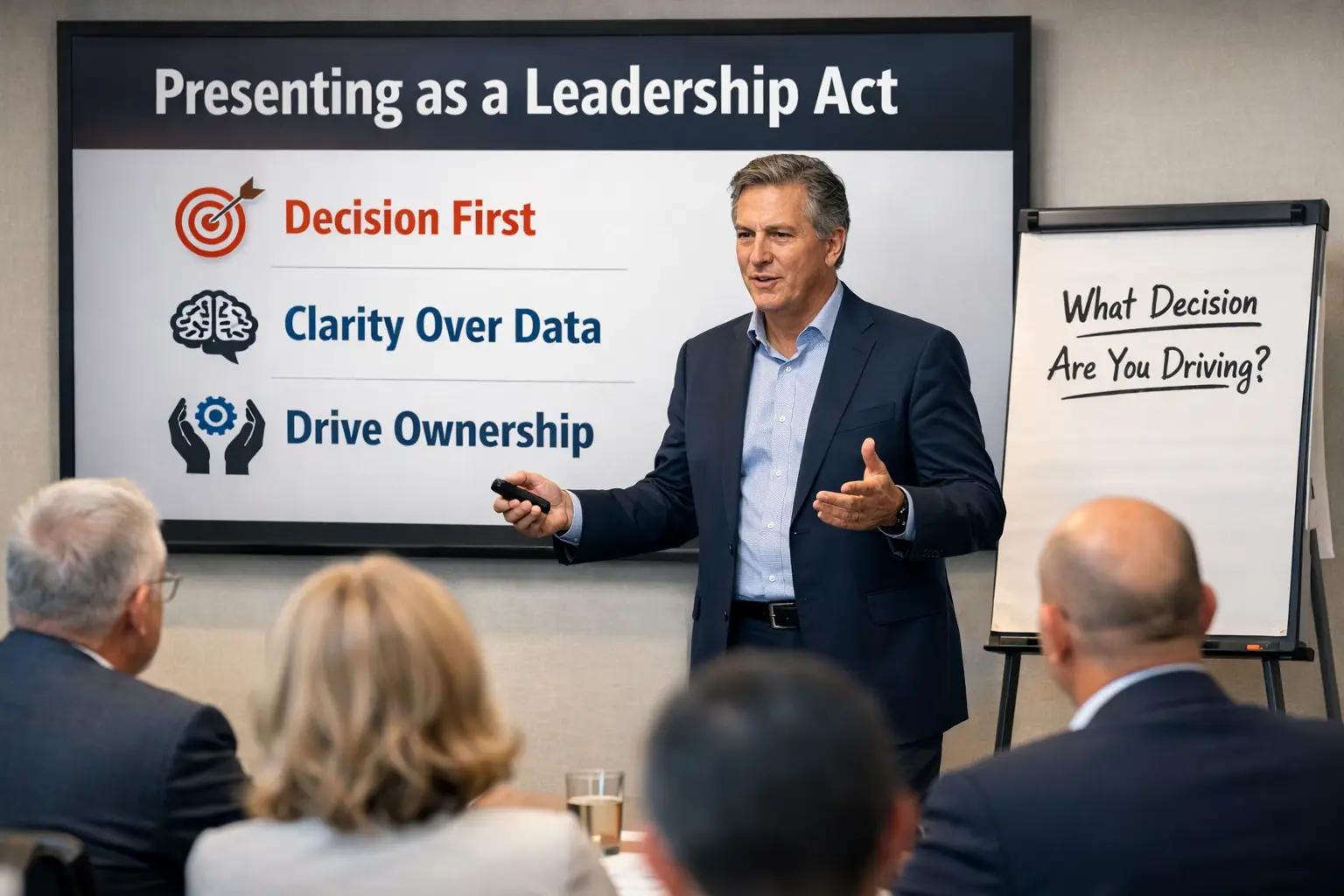
Early in my career, I believed strong presentations were primarily about preparation: solid analysis, logical structure, and well-designed slides. Over time — and especially through years of training and coaching senior leaders across industries and cultures — I learned that this belief was incomplete.
Presentations are not a communication skill.
They are a leadership behavior under pressure.
This insight has shaped not only how I present myself, but also how I design leadership training for senior leaders who present regularly — to executive teams, boards, and critical stakeholders.
A moment that changed how I look at presenting
Many years ago, but I remember as it was yesterday, I was presenting to a senior leadership team in a highly operational, time-pressured environment. The organization was dealing with volatility, competing priorities, and an overloaded decision agenda.
Technically, the presentation was strong:
- The analysis was thorough
- The slides were clean
- The logic was defensible
Yet the room never aligned. The discussion drifted. Questions multiplied without converging. At some point, a senior executive interrupted and asked: “What do you actually want us to decide?”
That question exposed something I now see repeatedly, both in executive meetings and in leadership training rooms: presentations fail not because of weak content, but because leadership intent is unclear.
This moment later became the starting point for how I coach executives on this, as well as designing training modules around presenting, decision-making, and ownership.
What training and coaching senior leaders taught me
In my work with senior leaders, in executive training programs, leadership team offsites, and individual coaching, this pattern appears again and again. Leaders struggle with presentations not because they lack expertise, but because:
- They try to be complete instead of decisive
- They let analysis replace judgment
- They assume clarity will “emerge” from information
Research consistently reflected in Harvard Business Review confirms this observation: effective presentations are decision-driven, not information-driven.
That is why, in training sessions, I start with a deceptively simple exercise: “Write down — in one sentence — what decision, commitment, or shift in thinking must result from your presentation.”
For many senior leaders, this is harder than expected. And that difficulty is exactly where learning begins.
Structure as an act of leadership
Another recurring insight from training senior teams is this: leaders consistently underestimate the cognitive load they place on their audience. In boardrooms and executive teams:
- Attention is fragmented
- Context is assumed
- Time pressure is constant
Structure, as emphasized repeatedly in HBR, is not a formality. It is a cognitive leadership tool.
In training, this becomes tangible through:
- Reworking real participant presentations
- Making structure explicit and visible
- Testing whether the audience can summarize the message in 30 seconds
Strong leaders learn to:
- Signal where the conversation is going
- Mark transitions deliberately
- Repeat the core message without dilution
Not because people are incapable, but because leadership means making it easier to think, decide, and act.
Authority comes from judgment, not detail
Many senior leaders enter training believing credibility comes from demonstrating depth: showing the full analysis, all scenarios, every risk. In practice, this often weakens authority.
Both research and experience converge on the same insight: Authority is demonstrated through judgment, not volume. In training settings, this becomes visible when leaders are challenged to:
- Explicitly state what matters most
- Name what matters less — and why
- Make trade-offs visible instead of hiding them in slides
Learning to leave things out, consciously and transparently, is one of the most powerful shifts leaders experience. Trust increases, not decreases.
Storytelling as sensemaking, not performance
In leadership training, storytelling is often misunderstood. It is not about engagement or entertainment. Storytelling, when used well, is a sensemaking mechanism. Short, relevant experiences, often operational and sometimes uncomfortable, help leaders and teams:
- Interpret ambiguity
- Understand consequences
- Anchor abstract concepts in reality
In training, I apply a simple rule: If the story does not change how people understand the issue, it does not belong in the presentation.
This reframes storytelling from performance to leadership responsibility.
Executive presence is alignment
Another misconception that frequently surfaces in training is executive presence. Presence is not charisma. It is not performance. Experience and research show that presence emerges from alignment:
- Between message and intent
- Between words and behavior
- Between confidence and openness
In training sessions, this often shows up when leaders stop “delivering” presentations and start leading the thinking in the room. Silence, listening, and adjustment become part of the presentation, not distractions from it.
The ultimate test: ownership
Across all leadership programs I run, one criterion consistently distinguishes strong presentations from weak ones: Does this presentation increase ownership — or dilute it?
The best presentations:
- Clarify who owns what next
- Make decisions explicit
- Close ambiguity rather than prolong it
This is why training modules on presenting are always connected to:
- Decision forums
- Governance structures
- Follow-through and execution discipline
Agreement is secondary. Responsibility is the real outcome.
A final reflection
Years of training and coaching senior leaders have reinforced this lesson again and again: Presentation skills are not about slides, confidence, or technique. They are about:
- Decision clarity
- Cognitive discipline
- Judgment under pressure
- The willingness to lead in public
Or, put simply: Every presentation is a leadership moment, whether you intend it to be or not.
And that is exactly why presenting deserves a place as a serious leadership training topic, not a communication afterthought.
The Executive Presenting Framework
Over the years, working with senior leaders, one question consistently makes the difference between presentations that drift and presentations that lead. It is not about structure, storytelling, or confidence.
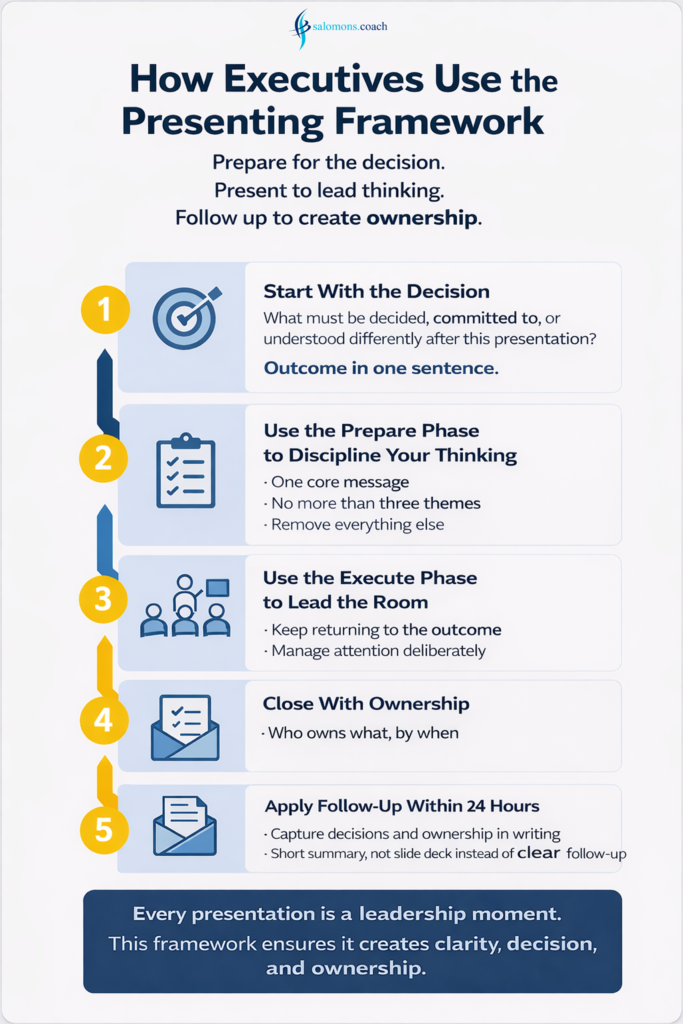
It is about clarity of intent. therefore: always start with the decision, not the slides!
I have developed an executive presenting framework, a 3 phased approach with 14 clear steps to take, to deliver your killer presentation that create the results you need:
1. Prepare: Lead Before You Enter the Room
2. Execute: Lead the Thinking in the Room
3. Follow-Up: Convert Clarity into Ownership
Resources available around the Executive Presenting Framework:
- The Framework – a 13 page document providing the full framework and checklist, with the critical questions you need to have answered, to get to the best presentation possible for the purpose you have in mind.
- A 4 hour training program, face-to-face or virtual, for max 6 persons at the time, where I guide you and some of your colleagues through all 14 steps of the framework, and each of you develop your first real-life killer presentation.
- A dedicated post on the executive presenting framework, providing more background on not only the steps, but also the why’s of each step. This provides already a good understanding, allowing you to transfer the knowledge gained for any future presentation you need to deliver.