The Leadership Iceberg

Leadership coaching
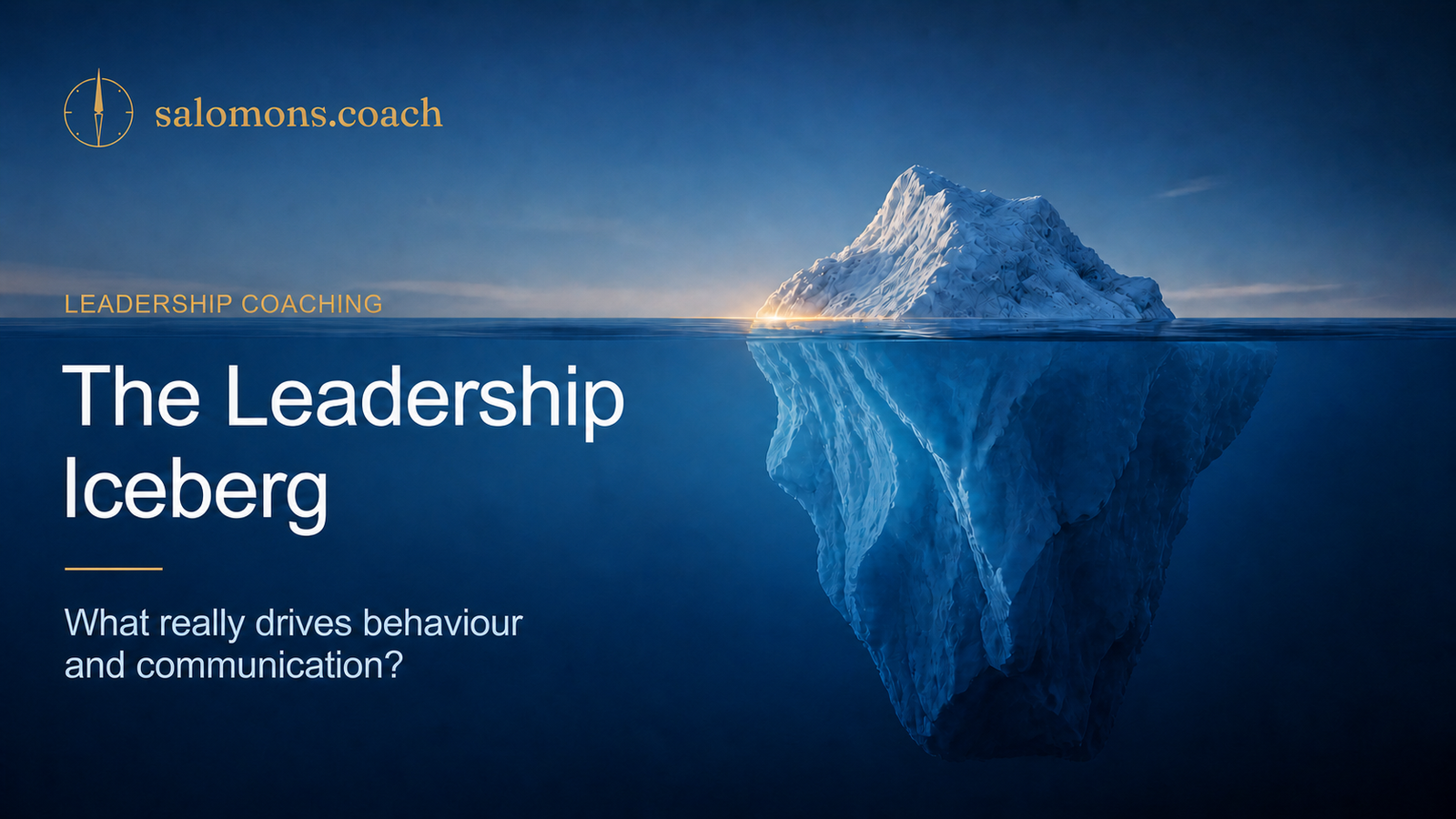
The Leadership Iceberg
What really drives behaviour and communication?
When people experience someone’s leadership, they mainly see what happens above the surface.
They notice what the leader says, how they react to difficult news, whether they listen, which decisions they make and whether they keep their promises. These visible moments influence trust, engagement and performance.
But they are only the tip of the iceberg.
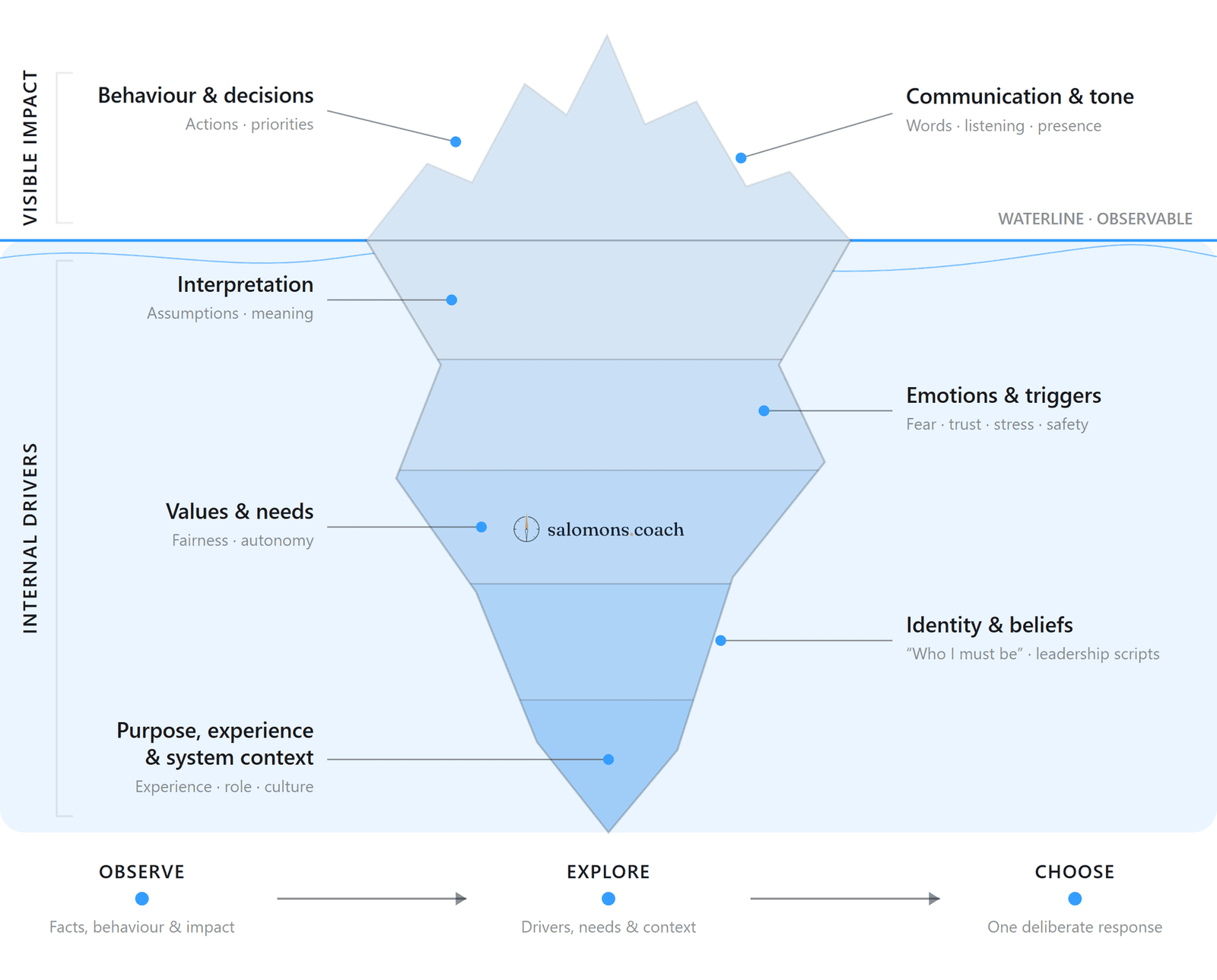
Beneath every visible response lies a combination of assumptions, emotions, values, needs, beliefs, experiences and organisational pressures. In my leadership coaching, I use the iceberg model to help leaders understand how these internal processes shape what other people eventually see and hear.
It enables us to move beyond the question, “What should I do differently?” and explore the more powerful question:
“What is happening beneath the surface that makes me respond this way?”
Above the waterline: what others experience
The visible part of the leadership iceberg contains two closely connected elements.
Behaviour and decisions
This includes what a leader does, or does not do:
- Setting priorities
- Making decisions
- Delegating responsibility
- Giving feedback
- Responding to mistakes
- Managing conflict
- Following through on commitments
These actions communicate what really matters. A leader may say that experimentation is encouraged, for example, but react critically when the first experiment fails. Employees will usually believe the visible behaviour more than the stated intention.
Communication and tone
Communication includes much more than words. Employees also notice:
- Whether the leader listens or interrupts
- Which questions they ask
- Their tone, facial expression and body language
- How transparently they communicate
- What they repeatedly emphasise
- What they avoid discussing
- How they respond under pressure
Even silence communicates. When a leader does not address an important concern, employees will often create their own explanation.
Because leaders have formal authority, their behaviour and communication are amplified. A brief dismissive response can reduce psychological safety across an entire team. A calm and curious response to difficult news can encourage honesty and shared responsibility.
Beneath the waterline: what shapes the response
The larger part of the iceberg is less visible. Some of it may also be outside the leader’s immediate awareness.
Interpretation and assumptions
Leaders do not respond directly to reality. They respond to their interpretation of it.
A missed deadline might be interpreted as a lack of commitment, poor planning, insufficient capability or a sign that the workload is unrealistic. Each interpretation invites a different response.
In coaching, I therefore help leaders separate observation from interpretation:
- What actually happened?
- What meaning did you give it?
- What did you assume about the other person?
- Which alternative explanations might also be possible?
This distinction can fundamentally change a conversation.
Emotions and triggers
Pressure, uncertainty and conflict activate emotional responses. A leader may feel anxious, frustrated, disappointed, threatened or powerless—even when the only visible sign is a sharper tone, withdrawal or increased control.
Emotions are not leadership failures. They provide information about what a person perceives to be important or at risk.
When a leader can notice, “I am becoming anxious, and my instinct is to take control,” a small but important space appears between the trigger and the response. Inside that space, the leader has a choice.
Values and needs
Leaders are influenced by what they value and need. This might include fairness, achievement, stability, autonomy, recognition, belonging or trust.
A strong desire for reliability may lead to useful structure and clarity. Under pressure, the same desire may become excessive monitoring. A commitment to harmony may help a leader build relationships, but it may also make necessary conflict more difficult.
The value itself is usually not the problem. The question is whether the leader is expressing it consciously and constructively.
Identity and beliefs
At a deeper level, leaders carry beliefs about themselves, other people and leadership:
- “A good leader always has the answer.”
- “Showing doubt will undermine confidence.”
- “If I do not stay in control, quality will suffer.”
- “Conflict damages relationships.”
- “People cannot be trusted until they have proved themselves.”
- “I am responsible for solving every problem.”
These beliefs operate like internal leadership scripts. They influence which behaviours feel natural, uncomfortable or impossible.
Leadership development becomes more sustainable when leaders learn to recognise and examine these scripts instead of automatically following them.
Purpose, experience and system context
At the base of the iceberg lie formative experiences, personal purpose and the environment in which the leader works.
Previous successes and failures shape current expectations. Organisational culture, incentives, workload, hierarchy and senior-management pressure also influence behaviour.
What appears to be an individual communication problem may therefore be partly sustained by the surrounding system. I use the iceberg model to explore this interaction—not to psychoanalyse or blame the leader.
How I use the model in leadership coaching
I usually begin with a specific leadership moment: a difficult conversation, a decision that created resistance, feedback that was not well received or a situation in which the leader became more controlling or withdrawn.
We first examine the visible layer:
- What did you do?
- What did you say?
- What did other people observe?
- What was the effect?
We then move beneath the waterline:
- What did you believe was happening?
- What were you feeling?
- What were you trying to achieve, protect or avoid?
- Which value or need was important to you?
- Which belief about leadership influenced your response?
- How did the organisational context contribute?
Finally, we return above the surface and consider a more deliberate response.
Observe → Explore → Choose
This movement—downward into awareness and back upward into choice—is where much of the coaching value lies. Insight alone is not enough. The insight must eventually become visible through different behaviour and communication.
The initial hurdles leaders need to overcome
Using the iceberg model can appear straightforward. In practice, however, looking beneath the surface asks something different of leaders.
Leaders are usually accustomed to analysing external problems, making decisions and creating solutions. They may be less accustomed to examining their own internal processes. Several initial hurdles commonly emerge during coaching.
Separating observation from interpretation
One of the first challenges is distinguishing what happened from the meaning the leader gave it.
“My team is resistant” is an interpretation. “Three team members questioned the proposed timetable” is an observation.
When the two are treated as the same, assumptions quickly become facts. Coaching helps the leader slow down and consider other possible explanations.
Slowing down automatic reactions
Leadership often requires speed, but speed can also make habitual reactions difficult to see.
A leader may move almost instantly from feeling challenged to defending a decision, or from sensing risk to increasing control. The iceberg model asks the leader to pause long enough to notice what happened between the trigger and the visible response.
Accepting vulnerability
Exploring fear, uncertainty, identity or unmet needs can initially feel uncomfortable. This is particularly true for leaders who believe that leadership requires constant confidence and certainty.
Recognising anxiety or doubt does not make someone a weaker leader. It makes it possible to prevent those emotions from unconsciously directing their behaviour.
Moving beyond intellectual analysis
Some leaders understand the model conceptually but continue to approach it as another analytical exercise. They can explain a pattern without fully connecting with the emotion, physical response or underlying need involved.
Coaching therefore needs to move beyond “I understand why I do this” towards “I can recognise when it is happening and make a different choice.”
Owning impact without becoming defensive
It can be difficult to accept that a positive intention produced a negative effect.
A leader may have wanted to protect quality, create clarity or maintain momentum. Their team may nevertheless have experienced their behaviour as controlling, dismissive or impatient.
The iceberg model does not invalidate the leader’s intention. It helps them hold intention and impact together.
Avoiding self-judgement
Discovering a limiting belief or reactive pattern can lead to embarrassment or self-criticism. That usually reduces openness and learning.
The aim is not to label the response as good or bad. It is to understand what the pattern was trying to achieve, whether it remains helpful and what alternative is now available.
Not using the model to diagnose other people
The iceberg model is most useful as a tool for self-reflection. Leaders may initially be tempted to speculate about what lies beneath another person’s behaviour.
Those assumptions should be converted into questions rather than presented as facts. Curiosity creates dialogue; amateur diagnosis usually closes it down.
Recognising the influence of the system
Not every leadership difficulty is caused by an individual belief or emotional trigger. Workload, competing targets, organisational culture, incentives and senior-management expectations can all reinforce certain behaviours.
Effective coaching examines both the person and the environment in which the behaviour occurs.
Turning insight into visible change
A final hurdle is translating awareness into action.
A leader may reach an important insight during coaching, but the people around them can only experience development when it becomes visible. The session therefore needs to end with a concrete behavioural experiment: a different question, a clearer conversation, a delegated decision or a new response to disagreement.
The first objective is not to take the leader as deep as possible. It is to create enough safety, curiosity and precision for honest reflection—while maintaining responsibility for the leader’s impact.
A recurring pattern in coaching
Consider a team that challenges an important change.
A leader may interpret the questions as resistance. This triggers anxiety about losing momentum. The leader values decisiveness and believes that a strong leader should project certainty. They therefore cut the discussion short and communicate the decision more forcefully.
Employees see impatience and limited openness. They become quieter, which the leader may then interpret as disengagement or a lack of ownership. The pattern reinforces itself.
In coaching, we can slow this sequence down. A more conscious response might be:
“I notice that I am interpreting these questions as resistance. I feel pressure to move quickly, and that is making me less open. Let me clarify what has already been decided, what remains open and which risks you believe we need to consider.”
The leader has not surrendered authority. They have made their internal process more conscious and converted it into clearer leadership.
Outcomes I have seen with clients
With some of my clients, working with the iceberg model has contributed to meaningful changes in how they lead.
Leaders have become better able to:
- Recognise emotional triggers before reacting
- Distinguish facts from assumptions
- Handle disagreement without immediately becoming defensive
- Replace micromanagement with clearer expectations and accountability
- Delegate with greater confidence
- Address difficult issues earlier and more directly
- Explain the reasoning behind decisions more transparently
- Remain curious and present during challenging conversations
These individual changes can also affect the wider team. When leaders become less reactive and more transparent, employees are often more willing to speak openly, raise concerns and take responsibility. Conversations become more constructive, and disagreements are less likely to become personal or remain unresolved.
The outcomes are not created by the model alone. The model provides a language and structure for the deeper reflection, experimentation and practice that development requires.
Five questions leaders can use
Leaders can apply the iceberg model by asking themselves:
- What was observable?
Describe the behaviour and communication without immediately judging them. - What interpretation did I make?
Separate facts from assumptions and consider other possible explanations. - What was I feeling or protecting?
Identify the emotion, need, value or perceived risk behind the response. - Which leadership belief was active?
Ask what you believed you had to do, prove or prevent in that moment. - What response would better serve my purpose?
Choose behaviour that fits both the situation and the leader you want to be.
Leadership development happens below the surface
Visible behaviour matters. Leaders remain responsible for their actions, words and impact.
But sustainable change rarely comes from correcting behaviour alone. Telling a leader to “listen more,” “delegate better” or “be less controlling” may address the symptom without changing the internal process that repeatedly produces it.
The iceberg model adds the necessary depth. It helps leaders connect what they do with how they interpret, feel, believe and respond to their environment.
The aim is not to eliminate emotion or perfectly understand every internal process. It is to become sufficiently aware of what is happening beneath the surface to make a more deliberate choice above it.
For me, that is at the heart of mature leadership: not leading without pressure, assumptions or emotion, but recognising their influence—and consciously choosing what happens next.

You may also like

Five Steps to Take Immediate Control of a Crisis

Most Leadership Teams Lack Dialogue