How to create ownership in organizations
Executive summary
This article contains (1) an executive summary, (2) a chapter on how to build a leadership culture where ownership is a fundamental part of how people work together, (3) a practical example (case study) based on one of my recent projects and (4) download . component
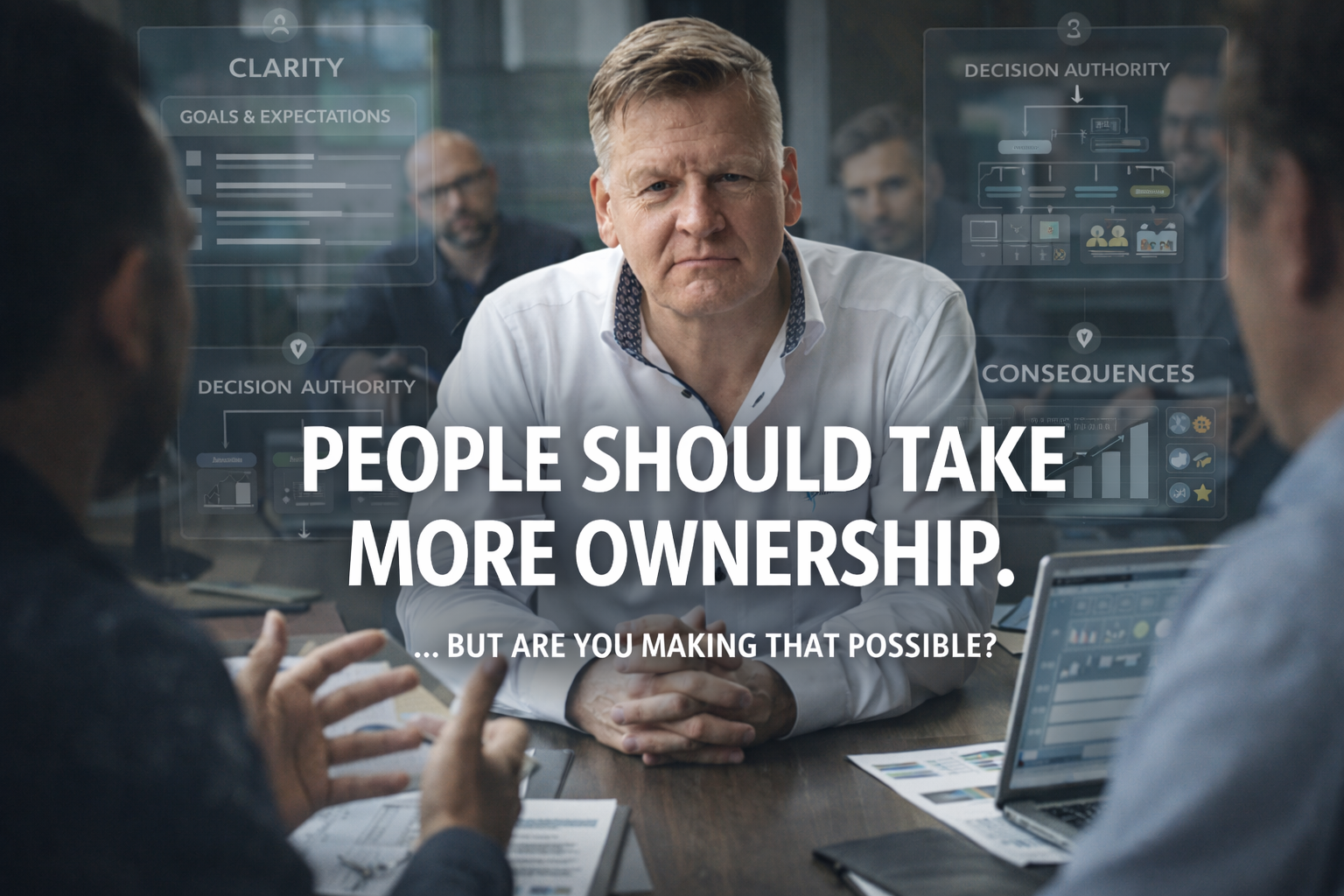
Many organizations struggle with ownership and conclude that people need to “step up” or change their mindset. In practice, ownership is rarely a motivation issue. It is the predictable outcome of how work is designed, how decisions are made, and how leadership behaves under pressure.
Ownership breaks down when goals are unclear, accountability is decoupled from authority, and leaders step back in as soon as things become uncomfortable. In such environments, asking for ownership produces caution rather than commitment.
Strong ownership emerges when people have clarity about what they own and why it matters, real decision-making authority within clear boundaries, and visible consequences that connect decisions to outcomes. Psychological safety is essential; without it, responsibility becomes a personal risk rather than a shared norm.
Leadership behavior is decisive. What leaders do in moments of stress matters far more than what they say. Consistent behavior, supported by a clear operating rhythm and peer accountability, turns ownership from an expectation into a cultural reality.
Ownership does not grow because people care more. It grows because the system allows it, expects it, and reinforces it every day. Organizations that want more ownership must stop demanding it and start designing for it.
Case study: In a large-scale, 24/7 operations environment within a global logistics organization, redesigning clarity, decision authority, leadership behavior, and operating rhythm led to faster decisions, stronger accountability at supervisor level, and a measurable reduction in escalation to senior management.
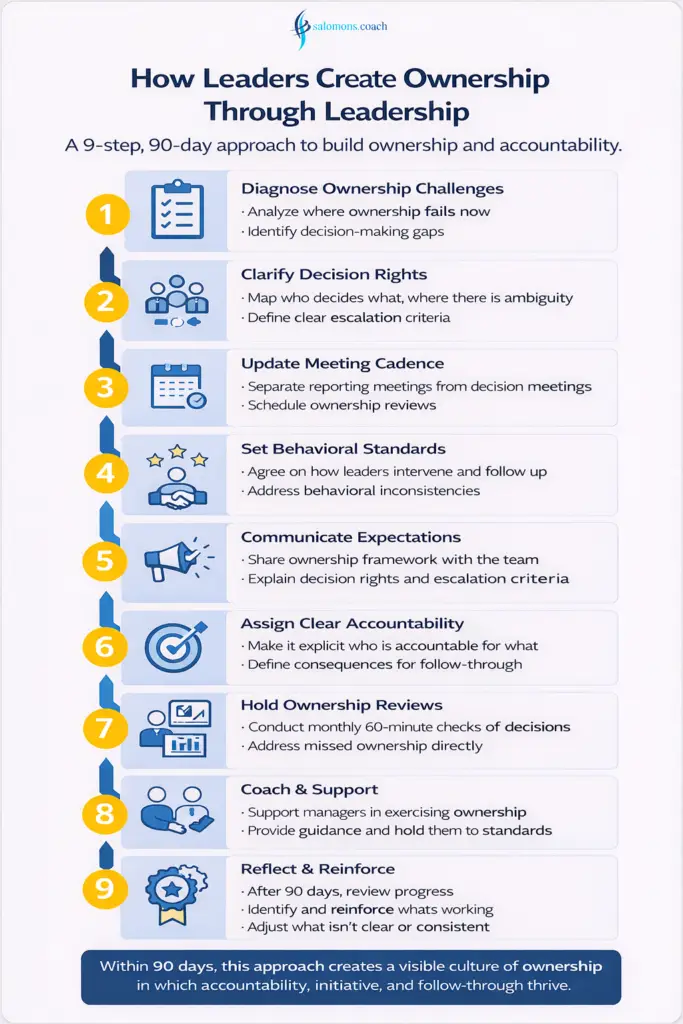
The framework summarized in one infographic.
Click the infographic for downloading the full framework, a 12 page checklist for leaders.
Why ownership in organizations is built by design, not by slogans
“People should take more ownership.”
It is one of the most common frustrations I hear in organizations. The remark is usually sincere. Leaders mean it. They want initiative, responsibility, and accountability to live deeper in the organization. And yet, the sentence is almost always followed by initiatives aimed at changing mindsets.
That is precisely where things start to derail.
Ownership is rarely a mindset problem. In practice, it is far more often the logical result of how an organization is designed, how leadership behaves, and what gets reinforced day after day. If the system discourages ownership, no amount of encouragement, storytelling, or cultural slogans will compensate for that.
If you want more ownership, stop asking people to “step up” and start examining what you are structurally asking them to step into.
Clarity comes before commitment
Ownership cannot exist in an environment of ambiguity. People cannot take responsibility for outcomes when they are unclear about what they are actually responsible for. They need clarity about the scope of their role, the purpose behind their work, and the standard by which success will be judged.
In many organizations, goals are layered, priorities shift frequently, and expectations remain implicit. The result is not laziness or indifference, but hesitation. People slow down because they are unsure which trade-offs are acceptable and which mistakes will later be punished.
Ownership grows when objectives are explicit, stable, and meaningful enough for people to truly commit to. Motivation follows clarity, not the other way around.
Accountability without authority leads to withdrawal
Few things are more demotivating than being held accountable for outcomes you cannot meaningfully influence. Yet this happens every day. People are asked to “own” results while decisions remain centralized, escalations are encouraged, and leaders step back in as soon as things become uncomfortable.
In such systems, responsibility becomes symbolic rather than real.
True ownership requires that decision rights are clear and respected. People must know where they are expected to decide independently and where escalation is appropriate. And just as importantly, leaders must resist the urge to override decisions simply because it feels faster or safer in the moment.
When decisions are routinely reversed or second-guessed, people do not step up. They step back. Over time, initiative is replaced by compliance, and ownership quietly erodes.
Ownership requires consequences, not protection
Ownership becomes real when people experience the consequences of their choices. That does not mean punishment. It means connection.
When teams see how their decisions affect customers, colleagues, and results, responsibility becomes tangible. Learning becomes grounded in reality rather than abstraction. However, many leaders unintentionally remove this connection by shielding teams from the impact of their decisions, often with good intentions.
By fixing things quietly or absorbing the fallout at a higher level, leaders also remove the opportunity to learn. Ownership grows when feedback is direct, timely, and clearly linked to decisions and outcomes, without blame, but also without rescue.
Without psychological safety, ownership is a risk
No one takes ownership in an unsafe environment.
People only assume responsibility when they believe that mistakes can be discussed openly, that learning matters more than fault-finding, and that dissent is seen as contribution rather than disruption. Psychological safety is therefore not a soft cultural ambition. It is a hard leadership responsibility.
Importantly, safety is not created by words but by behavior. Teams watch closely how leaders react when something goes wrong, when targets are missed, or when assumptions are challenged. These moments define whether ownership is encouraged or quietly punished.
What leaders do matters more than what they say
Organizations often underestimate how quickly ownership disappears when leadership behavior becomes inconsistent. Under pressure, some leaders revert to micromanagement, reverse decisions without explanation, or take credit for success while distributing blame for failure.
These behaviors send powerful signals. They teach people exactly how much ownership is truly expected, regardless of what is stated in strategy documents or town halls. Culture is shaped in moments of stress, not in moments of alignment.
Ownership survives only when leaders remain consistent, especially when it is uncomfortable to do so.
Ownership lives in rhythm, not in escalation
Strong ownership does not emerge from ad-hoc interventions or escalations when problems arise. It is supported by a clear operating rhythm in which responsibility becomes visible and normal.
Regular moments to review progress, explain decisions, and address issues create a disciplined cadence. In such a rhythm, accountability is not personal or political. It is part of how work gets done. This is not about control, but about creating predictability and shared responsibility.
Peer accountability is where ownership becomes cultural
The most sustainable form of ownership is not vertical. It is horizontal.
When colleagues hold each other to agreements, address behavior directly, and protect shared standards, responsibility shifts from “the manager” to “us.” At that point, ownership no longer depends on hierarchy or individual leaders. It becomes embedded in the way people work together.
The bottom line
Ownership does not grow because people suddenly care more. It grows because the system allows it, expects it, and consistently reinforces it. Clear goals. Real authority. Visible consequences. Psychological safety. Consistent leadership behavior. A shared operating rhythm. Mutual accountability.
Stop asking for ownership. Start designing for it.
Case study from my personal experience: how ownership was rebuilt in a large-scale operations environment
In a large, 24/7 operational hub within a global logistics organization, senior leadership expressed a familiar concern. Performance issues were being escalated quickly, supervisors waited for direction, and managers felt they were constantly firefighting instead of leading. The recurring conclusion was that “people were not taking enough ownership.”
At first glance, this looked like a motivation problem. In reality, it was a design problem.
The starting point
The operation was complex, high-volume, and time-critical. Managers and supervisors were experienced and committed, but ownership had gradually shifted upward. Decisions were escalated by default, roles between managers and supervisors had blurred, and leadership behavior under pressure had become inconsistent.
Supervisors were held accountable for outcomes they could not fully influence. Managers stepped back into operational detail whenever performance dipped. The system rewarded escalation and compliance rather than responsibility.
Ownership was present in intent, but absent in practice.
The intervention
The leadership program did not start with mindset sessions or motivational messaging. It started with making ownership visible and concrete.
First, clarity was restored. The leadership team explicitly defined what supervisors owned, what managers owned, and where escalation was expected or discouraged. This was not documented in abstract role descriptions, but translated into daily operational decisions, shift rhythms, and handover moments.
Second, decision authority was deliberately pushed back down. Supervisors were given explicit decision space within clear boundaries, and managers committed to not stepping back in unless those boundaries were crossed. This was uncomfortable at first, especially under performance pressure, but it was consistently reinforced.
Third, leadership behavior became the focal point. Managers examined how their own actions either strengthened or weakened ownership. Moments of micromanagement, silent overrides, or “fixing it quickly” were surfaced and discussed openly. This created a shared language for ownership, grounded in behavior rather than intent.
Fourth, a disciplined operating rhythm was introduced. Regular moments were created in which supervisors reported on decisions taken, trade-offs made, and outcomes achieved. These were not reporting meetings, but accountability conversations. Responsibility became visible and normal, rather than exceptional.
Finally, peer accountability was strengthened. Managers held each other accountable for staying out of the operational detail. Supervisors were encouraged to challenge unclear expectations or inconsistent behavior. Psychological safety was not discussed as a concept, but built through repeated behavior.
What changed
Ownership shifted noticeably within months.
Supervisors stopped escalating by default and started making decisions within their mandate. Managers spent less time firefighting and more time leading, coaching, and anticipating. Conversations moved from “what went wrong” to “what did you decide and why.”
Performance discussions became sharper, but also calmer. Fewer surprises reached senior leadership, not because issues disappeared, but because they were addressed earlier and closer to where the work happened.
Benefits and consequences
The benefits were tangible. Decision speed increased. Engagement among supervisors improved. Leadership capacity expanded without adding layers or headcount. The operation became more resilient under pressure.
There were also consequences. Not everyone was comfortable with the increased responsibility. Some supervisors chose to step out of their role. Some managers struggled to let go of control and needed explicit feedback on their behavior. Ownership exposed gaps that had previously been hidden by escalation.
That was not a failure of the program. It was evidence that ownership had become real.
The key lesson
Ownership was not reinforced by asking people to care more. It was reinforced by redesigning clarity, authority, leadership behavior, and rhythm.
Once the system changed, behavior followed.
This case illustrates the core message of the article: ownership is not something you demand from people. It is something you deliberately build through how leadership shows up and how the organization is designed to work every day.
The 12-week re-enforcing ownership action plan
For your benefit, I have create a detailed action plan on how leadership can re-enforce ownership in practice. The action plan contains:
- General leadership guidelines on how to apply the action plan in your daily
- Personal leadership guidelines (your behavior) that will make applying the action list most effective
- A 12 week action plan how you can create more ownership
- An overview of what success looks like if you follow the action plan
- Two infographics summarizing this all
- what is ownership
- the action plan

You may also like
Five Steps to Take Immediate Control of a Crisis

Most Leadership Teams Lack Dialogue