
Wat gezien wordt, wordt herhaald – Brandweer versus Preventers
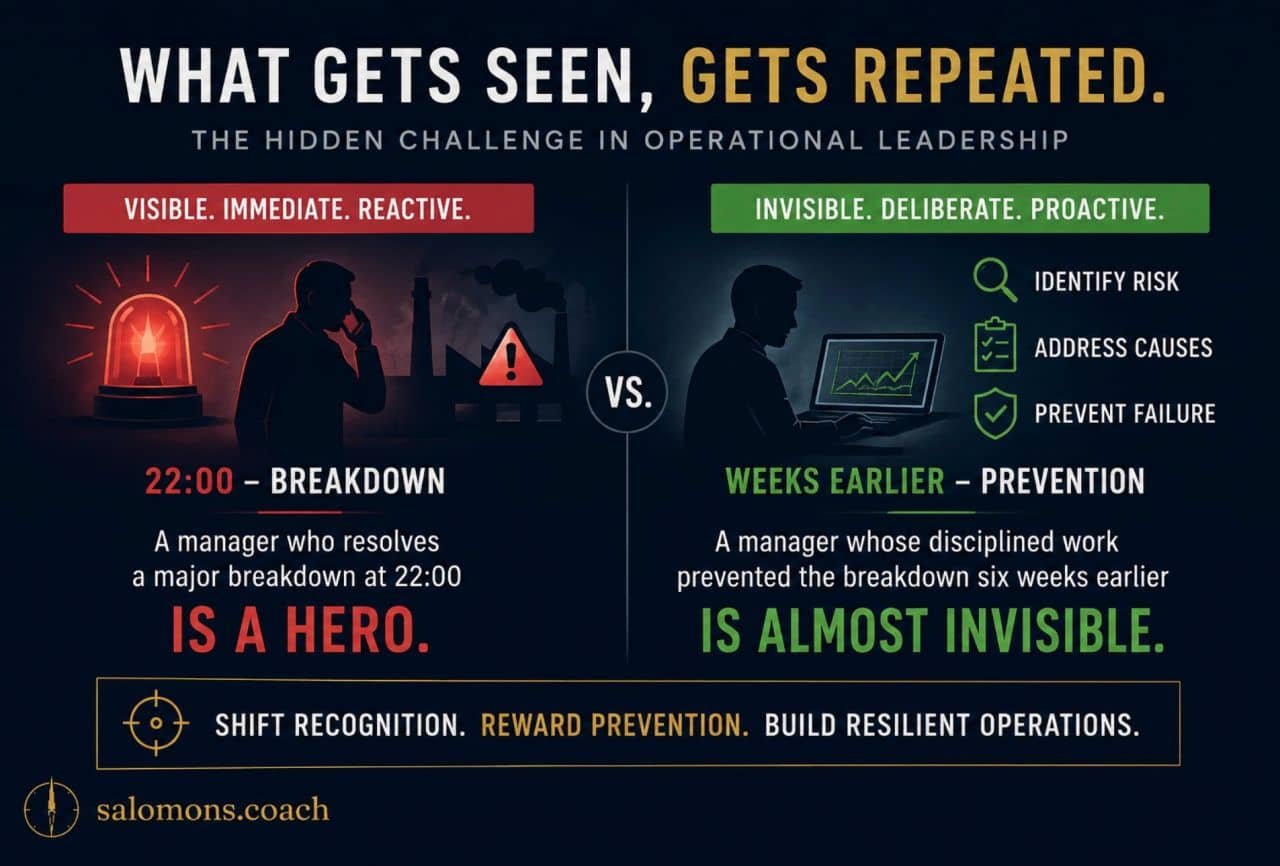
Nobody gets promoted for the breakdown that never happened.
It is 22:00 on a Thursday. A packaging line goes down. The site manager picks up the phone, pulls in two technicians, and has production running again by 03:00. By Friday morning the story has travelled through the building. The director thanks him in the management meeting. He is a hero.
Six weeks earlier, at another site in the same group, a different manager noticed that changeovers on a similar line were taking four minutes longer than usual. She moved a maintenance window, trained two operators on an early-warning check and tightened the shift handover. Nothing happened. No breakdown, no overtime, no story.
She is almost invisible.
Here is the contradiction. Organisations say they value prevention. They reward recovery. The rescue gets the applause, the prevention gets silence, and every time that happens the organisation learns where careers are made.
The problem is not the firefighter. Recovery skills matter, and crises will always come. The problem is what the rest of the organisation copies. What gets seen, gets repeated.
So the real question for a senior leader is not how to reward heroes less. It is how to see the leaders and employees who make heroism unnecessary.
| The visible leader | The invisible leader | |
|---|---|---|
| Moment | 22:00, the breakdown | Weeks earlier, the weak signal |
| Work | Reactive, immediate | Deliberate, proactive |
| Bewijs | A story everyone tells | A trend line that stays flat |
| What the organisation usually gives | Praise, exposure, promotion | Little attention, “a bit rigid” |
| What the organisation needs more of | Some | Much more |
The first column earns attention by itself. The second only gets it when a senior leader goes looking.
The coaching case: the manager he never needed to call
A few years ago I coached the Operations Director of a manufacturing and logistics group. I will call him Mark. Six sites, around 1,400 people, demanding customers. Mark was energetic and respected, and proud of what he called a “can-do” culture.
In our third session I asked him which of his site managers he trusted most. He did not hesitate. Pieter, who ran the largest site. “When something goes wrong, Pieter fixes it. Nights, weekends, whatever it takes.”
Then I asked which site had the fewest unplanned stops, the most stable output and the fewest quality complaints over the last three years.
He opened his laptop. It was not Pieter’s site. It was a smaller one, led by Anouk. Lowest downtime, lowest overtime, lowest absenteeism, fewest customer escalations. Three years in a row.
“I barely talk to her,” he said. “There is never a reason to.”
There was never a reason to talk to her, because she had removed the reasons.
The resistance
Mark did not accept this easily. His first answer was that Anouk had an easier site. Newer equipment, a simpler product mix. His second was that Pieter carried the real complexity of the group.
So we tested it. Mark spent a full day at Anouk’s site, without an agenda. He came back irritated, and then quiet. Her equipment was not newer. Her product mix was not simpler. What was different was routine: a ten-minute stability review every morning, a near-miss log that people actually used, maintenance windows she refused to give up under pressure, and team leaders who could run the site without her.
The mirror
Then we looked at his diary for the previous eight weeks. Close to 70 percent of his time with site managers had gone to escalations, recovery plans and urgent calls. The sites that ran well received almost nothing. Without meaning to, Mark had built a system in which the fastest route to the director’s attention was to have a problem.
The side effects were easy to find once he looked. Ambitious young managers asked to work at Pieter’s site, because that was where the visibility was. Two of Anouk’s best team leaders had asked for transfers. Her promotion discussion had stalled because she “lacked exposure to complex situations”.
Mark put it sharper than I would have:
“I have been promoting the fire brigade and ignoring fire prevention.”
What followed was not one intervention. It was a change of routine, his own first and then his leadership team’s. The rest of this post draws on what we built together, and on what I have seen work in other organisations since.
Why prevention stays invisible
Mark was not a poor leader. He was responding to a pattern that sits inside almost every operation. Four forces keep prevention in the dark. Recognise one and you will usually find the other three.
Force 1: You cannot see a non-event. A breakdown has a time, a place and a cost. A prevented breakdown has none of them. Nelson Repenning and John Sterman captured this in the title of their MIT study, Nobody Ever Gets Credit for Fixing Problems that Never Happened. They showed how organisations fall into a capability trap: more firefighting leaves less time for improvement, which produces more fires.
Force 2: Heroism feels good. Crisis brings adrenaline, urgency and gratitude, for the leader who solves it and for the senior leader who watches. Prevention brings calm. Calm does not produce stories.
Force 3: We reward A while hoping for B. Steven Kerr named this almost fifty years ago. We hope for stability and quality. We reward visible effort, overtime and rescue. People follow what is rewarded, not what is said.
Force 4: Recovery becomes normal. When the late-night call happens often enough, nobody notices it any more. Diane Vaughan called this the normalisation of deviance. The recovery becomes “how it works here”, and the leader who prevents it starts to look like the exception.
The cost is real. Firefighting eats senior attention, wears out your best people and hides weaknesses in the system. It also teaches your talent pipeline the wrong lesson: if you want to be noticed, wait for something to break.
The better a leader prevents, the less visible that leader becomes. The weaker the system, the more heroes it produces.
What preventive leaders actually do
Excellent performance is not a talent. It is a set of habits, repeated when nobody is watching.
Nothing at Anouk’s site looked spectacular. That was the point. Karl Weick and Kathleen Sutcliffe found the same signature in high reliability organisations: a preoccupation with failure and a strong sensitivity to what happens on the floor.
Six habits of the invisible leader
- They read weak signals. A changeover that takes four minutes longer. A near miss. An operator who hesitates. Information, not noise.
- They fix causes, not symptoms. A problem that returns gets a root-cause conversation, not another workaround.
- They keep standards alive. Clear work standards, clean handovers, visual management, and a regular check whether the standard still fits reality.
- They make early bad news safe. The operator who flags a risk is thanked, not questioned. Problems surface while they are still small and cheap.
- They protect time for maintenance and improvement. Even under pressure. Especially under pressure.
- They build teams that see what they see. Performance does not depend on the leader being on site.
How to recognise them
These leaders rarely bring a good story to the management meeting. You find them through different evidence:
| Look for | Rather than |
|---|---|
| Stable results over two or three years | One strong quarter |
| Planned work far outweighing unplanned work | Impressive recovery times |
| A high number of near misses reported | A low number of incidents reported |
| Team leaders who run the unit in the manager’s absence | A manager who is always there |
| Few escalations to you | Many updates to you |
The same applies beyond managers. The technician who adjusts a setting before it drifts. The planner who spots a capacity clash three weeks out. The team leader whose shift never needs an escalation. Every organisation has these people. Very few can name them.
What the senior leader must do
Prevention does not become visible by itself. Someone has to make it visible, and that someone sits at the top.
Mark’s shift came down to five choices:
- Audit your own attention. Look at your diary for the last eight weeks. Who got your time, and why? If the answer is “whoever had a problem”, you are funding firefighting with your scarcest resource. Mark set himself a rule: at least one third of his site time would go to units that were running well, to understand why.
- Change the question. “What went wrong?” trains people to report incidents. “What did you catch early?” trains people to look ahead. Erik Hollnagel calls this the move from Safety-I to Safety-II: learning from what goes right, not only from what goes wrong.
- Measure the invisible. Most dashboards track outcomes: downtime, defects, complaints. Add the leading indicators that show preventive work: planned versus unplanned maintenance, near misses reported, adherence to standards, stability of key processes. What you measure, you can see. What you can see, you can recognise.
- Rewrite the success story. In town halls and management meetings, tell the story of the breakdown that never happened. Name the person. Explain what they noticed and what they did. These stories take more effort to find. That effort is the message.
- Change who gets promoted. This is the real test. If promotion criteria reward “exposure to complex situations” and “visible impact”, you will keep promoting firefighters. Add explicit criteria for sustained stability, root-cause capability and the strength of the team a leader leaves behind.
Within a year Anouk was leading two sites. That single decision told the organisation more than any value statement could.
One caution. Do not punish the firefighter. Thank people for the rescue, and in the same breath ask: “What would it take for this never to happen again?” That question moves the applause from the rescue to the cure.
The routines, a rhythm that makes prevention visible
Intentions fade. Routines last. Culture is what leaders do repeatedly, not what they announce once.
These are the routines Mark installed for himself, refined over eighteen months and then rolled out to his leadership team. They run on four rhythms.
1. Daily: two minutes before the incidents
Open every daily review with one question, before anyone mentions what went wrong:
- What did we catch early yesterday, and who caught it?
It costs two minutes. It tells everyone that early detection is part of the job, not an extra.
2. Weekly: go and see what works
- A prevention visit. One unit per week that is running well, with one question: “What do you do that others don’t?” No agenda, no slides.
- A leading-indicator review. Planned versus unplanned maintenance, near misses reported, standard adherence. Reviewed before the lagging results, not after.
The order matters. When the leading indicators come first, the conversation is about causes. When they come last, nobody reaches them.
3. Monthly: tell the story and close the loop
- The breakdown that never happened. One named example of prevention, shared in the management meeting and in internal channels.
- The recurrence review. Every problem that occurred twice gets a root-cause owner and a date. A repeat problem is a system signal, not bad luck.
4. Quarterly and yearly: put your money where your attention is
| Rhythm | Routine | What it teaches |
|---|---|---|
| Quarterly | Recognition and bonus input explicitly include preventive contributions, for managers and employees | What we say we value is what we reward |
| Twice a year | Talent and promotion calibration on stability delivered, root-cause capability and team strength left behind | Careers are built on reliability, not rescue |
| Yearly | Attention audit: each senior leader reviews the share of time spent on escalations versus stable units | Leaders hold themselves to the same standard |
Signals that tell you the routines are working, or not
Do not rely on how the routines feel. Let the data speak:
| Signal | What it usually means | Adjust |
|---|---|---|
| Your diary still fills with escalations | Attention follows problems by default | Book the prevention visits first, as fixed appointments |
| Near-miss reports drop after a few months | People no longer believe it matters | Respond visibly to the next report, name who raised it |
| The “never happened” story is hard to find | Managers do not recognise prevention yet | Ask them to bring one example each to the next meeting |
| Leading indicators look good, incidents do not fall | The indicators measure activity, not prevention | Review with the floor what really predicts failure |
| Promotion shortlists look the same as before | The criteria changed on paper only | Challenge each candidate on stability delivered |
Rules for keeping the routines alive
- Protect them in a crisis. The first routine cancelled under pressure tells everyone which one was never real.
- Keep them short. A two-minute question every day beats a two-hour workshop every year.
- Change one thing at a time. Otherwise you cannot tell what worked.
- Go and see. A dashboard shows that nothing went wrong. Only a visit shows you why.
Noticing, not rescuing
A year after our first session, Mark summed up the change in one line: “My phone rings less, and I know more.” Unplanned downtime across the group had dropped. More telling, his site managers had started to compare stability instead of rescue stories.
A senior leader is tempted into one of two roles: the one who applauds the hero, or the one who asks why things went wrong. Both keep attention on the breakdown.
The real job is to notice. Go looking for the leaders and employees who make problems disappear before they start. Measure what they do. Tell their stories. Promote them. And keep doing it long after it stops feeling urgent.
The firefighter will always find you. The fire preventer will not.
Questions to reflect on
- Who in your organisation has not needed your attention for a long time, and do you know why?
- What share of your time last month went to problems, and what share to understanding success?
- Which leading indicators of prevention do you actually review, and in what order?
- When did you last tell the story of a breakdown that never happened?
- Looking at your last three promotions, did you reward rescue or reliability?
Verder lezen
- Nelson P. Repenning and John D. Sterman, Nobody Ever Gets Credit for Fixing Problems that Never Happened
- Steven Kerr, On the Folly of Rewarding A, While Hoping for B
- Karl E. Weick and Kathleen M. Sutcliffe, Omgaan met het Onverwachte
- Erik Hollnagel, Safety-I and Safety-II
- Diane Vaughan, The Challenger Launch Decision
Names and identifying details in the coaching case have been changed to protect client confidentiality.

Dit vind je misschien ook leuk

De meeste leidinggevende teams missen dialoog
Het is niet de werkdruk. Stop met het de werkdruk te noemen.
