Het is niet de werkdruk. Stop met het de werkdruk te noemen.
Salomons.Coach | Stress, workload and leadership
Het is niet de werkdruk. Stop met het de werkdruk te noemen.
Why the most common diagnosis of workplace stress is also the most misleading one, and what the research says we should look at instead.
Ask a leader why the team is stressed. You will hear one word. Workload.
Ask what they are doing about it. You will hear the same four remedies. Redistribute tasks. Encourage people to take time off. Offer a time-management course. Add a wellness app.
Then watch the stress stay exactly where it was.
This is not because leaders do not care. Most care a great deal. It is because the diagnosis is incomplete. Workload is the one stressor everybody can see, count and name. That makes it the default explanation for everything. It also makes it the most misleading one.
After decades of working with senior leaders, and after building my own stress and resilience profile for teams, I have come to a blunt conclusion. "Too much work" is usually a symptom we can count, standing in for causes we would rather not own.
The numbers are not in dispute
Stress at work is high, and it is not going away. In Gallup's State of the Global Workplace 2026 report, around 40% of employees worldwide said they experienced a lot of stress the previous day, still above the 38% measured before the pandemic. Leaders report more daily stress than the people they lead, not less: 46%.
In the Netherlands the trend is even clearer. The share of employees with work-related burnout complaints rose from 11.3% in 2007 to 19.0% in 2023, and reached 20.7% in 2025. That is roughly one in five. Among employees aged 25 to 34 it is 28%.

Now look at how we explain it. In 2023, Dutch employees lost 14.3 million days of absence to psychosocial strain at work. When asked for the cause, they attributed 10.3 million of those days to excessive workload. Conflict and emotionally heavy work together accounted for about 4 million.

I do not doubt those people. But notice what the question does. It offers a short menu, and "workload" is the item everybody recognises. "Werkdruk" has become the Dutch word for every kind of pressure at work. When one word has to carry all the weight, it stops telling you anything useful.
Misreading 1: "Workload" is three problems hiding in one word
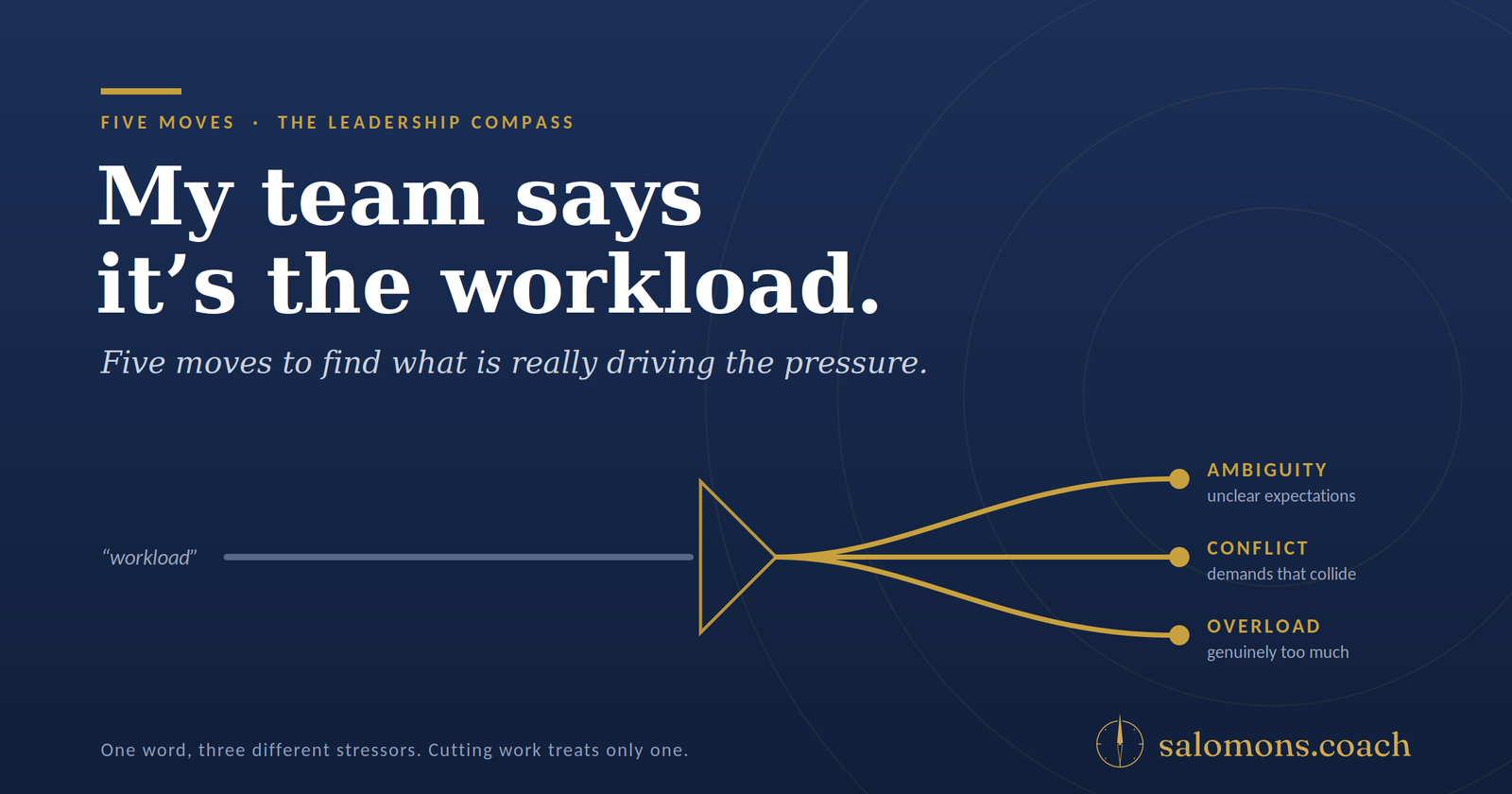
This month, Harvard Business Review published a meta-analysis by Gargi Sawhney and Mallory McCord that should change how leaders talk about stress. They reviewed sixty years of research, 515 studies covering nearly 788,000 employees, and compared three role stressors:
- Role ambiguity: not knowing what is expected, how your work will be judged, or where your responsibility ends.
- Role conflict: receiving demands, priorities or expectations that cannot all be met at the same time.
- Role overload: simply having more work than can reasonably be done.
The finding that matters: these three do different kinds of damage.

Role ambiguity came out as the most damaging stressor overall. It was most strongly linked to lower job satisfaction, engagement, commitment, perceived fairness and performance. Role conflict was the strongest predictor of burnout, psychological distress, counterproductive behaviour and the wish to leave. Overload, the one we always talk about, was most strongly linked to negative emotions and physical symptoms.
So the logic is simple, and uncomfortable. If you treat an ambiguity problem with a workload remedy, you get a lighter calendar and the same confusion. If you treat a conflict problem with a time-management course, you teach people to juggle faster between two directors who still disagree.
I wrote earlier about how ownership quietly erodes when clarity and rhythm are missing, in Wanneer gewoonten het overnemen: Eigenaarschap en resultaten op het werk terugwinnen. Most of the gaps I described there were not caused by lack of effort. Role ambiguity is the stress side of that same coin.
Misreading 2: Less load is always better
The second mistake is quieter. We assume that stress falls as work falls. It does not.
Research on the challenge-hindrance framework, starting with Cavanaugh and colleagues in 2000 and tested in a meta-analysis by LePine, Podsakoff and LePine in 2005, separates two kinds of demands. Challenge demands, such as volume, complexity and responsibility, strain people but also motivate them. Hindrance demands, such as ambiguity, role conflict and red tape, strain people and demotivate them. Challenge demands have a direct positive effect on performance. Hindrance demands have a negative one.

You will often see this drawn as the famous inverted U, attributed to Yerkes and Dodson. A word of honesty: their 1908 experiment was about mice and electric shocks, not managers and deadlines. The curve is a useful metaphor, not a law. But the practical point holds. A healthy amount of demand is not zero. It is a stretch you can recover from.
The other side of the curve matters too. Underload is not rest. Researchers note that burnout from overstimulation and boredom from understimulation overlap, because both leave people feeling worn out. One study found that "boreout" was driven less by having too little to do than by bureaucratic hassles and tasks that feel pointless.
I see this pattern regularly. A programme is paused after months of intensity. The calendar empties. The stress does not. It changes shape: loss of momentum, loss of meaning, a strange guilt about being idle. A workload lens reads that as spare capacity. It is not.
Misreading 3: If performance is fine, people are fine
This is where the workload story becomes dangerous.
Two findings from the Sawhney and McCord meta-analysis deserve a place on every leadership team's wall. First, role conflict was unrelated to task performance. People absorb competing demands, work around them and still deliver. Meanwhile the conflict drives burnout and the intention to leave. Second, overload was positively related to engagement. Heavy workloads can feel like a meaningful challenge, or demand full engagement just to stay afloat. Either way, the engagement can mask the emotional and physical strain underneath.
In Krijg je een burn-out? Lees dan dit! I described the trap of work as identity: saying yes to one more project because being needed feels good, until "always available" turns out to mean "no boundaries". From the outside, that looks like engagement. It is often the early stage of exhaustion.
Gallup's burnout research points in the same direction. In a study of nearly 7,500 full-time employees, the five factors most strongly linked to burnout were unfair treatment, unmanageable workload, lack of role clarity, lack of communication and support from the manager, and unreasonable time pressure. Only two of the five are about the amount of work. Gallup's own conclusion: burnout has less to do with expectations of hard work and high performance, and more to do with how people are managed.

And the cost is real. Employees who often experience burnout are 63% more likely to take a sick day and 2.6 times as likely to be actively looking for another job.
Misreading 4: We measure tasks, not attention
Ask people how busy they are and they will count projects. Ask them what exhausts them and they will describe something else: the meeting that should have been a message, the stakeholder who needs "five minutes", the colleague who always asks them first.
Rob Cross, Reb Rebele and Adam Grant called this collaborative overload. Over two decades, the time managers and employees spend in collaborative work grew by 50% or more. And the load is lopsided. In most organisations they studied, 20% to 35% of value-adding collaboration came from just 3% to 5% of employees. Those are your most helpful, most capable people. They are also the ones most likely to burn out, because they never say no to a good cause.
Microsoft's 2025 Work Trend Index shows how fragmented the day has become. During core hours, people are interrupted by a meeting, email or message roughly every two minutes, about 275 times a day. Most meetings are unscheduled. Nearly half of employees say their work feels chaotic and fragmented.
Greg McKeown made a related point in HBR more than a decade ago. One of the simple practices that helped a stressed executive was to give each activity his undivided attention, one thing at a time. That sounds soft. It is not. Fragmentation is load that never appears on a workload chart, and a workload chart is all most leaders look at.
Attention is also energy. I explored what back-to-back virtual meetings do to listening and connection in Cameras On or Off? What Really Happens in Virtual Meetings. The same logic applies here: the cost of a fragmented day is paid in attention long before it shows up in hours.
Misreading 5: The fix is more resilience
I work on individual resilience every week, and I believe in it. How people think about stress matters. Research by Alia Crum and colleagues showed that seeing stress as enhancing rather than only harmful changes how people respond to it. I explored that idea, and its limits, in How to make stress your friend, built on Kelly McGonigal's TED talk. Breathing, recovery and reframing help too. In The Five-Minute Reset I described the Stanford study that changed how I use breathing with executives. McKeown's advice to start very small, because you cannot take on stress in a stressful way, is some of the best practical advice on the subject.
But you cannot breathe your way out of an unresolved priority conflict between two directors. You cannot reframe your way out of a role nobody has defined. Individual resilience is the second line of defence. Work design is the first.
Sawhney and McCord put it plainly: well-being cannot be delegated entirely to wellness programmes, HR initiatives or individual resilience. It has to be built into how work is designed and managed.
What my own model had to learn
When I built the Salomons.Coach Stress & Team Resilience Profile, described in The Five Dimensions That Decide How You Carry Stress, I made one deliberate choice. It separates pressure from resources, so that a high workload is never confused with low capability. That choice has served teams well.
But pressure was a single number. Load. The evidence above says that one number is too few. An instrument that only asks about volume will only ever find volume. The next version therefore splits pressure into its parts: overload, role conflict and role clarity, with underload read as a signal rather than as good news. The "middle is best" logic applies to challenge. It does not apply to ambiguity or conflict, where less is simply better.
The research behind the current dimensions is in The New Science of Stress at Work; this post is, in a sense, its first correction. I share this because the same trap sits inside most engagement surveys and pulse checks. If your questions only ask about workload, your answers will only ever say workload.
Ask better questions
Sawhney and McCord suggest three direct questions for pulse surveys and one-to-ones. I add two from my own practice.
- Do you know what is expected of you, and how your work will be judged? Tests for ambiguity.
- Are you receiving requests that cannot all be met? Tests for conflict.
- Do you have enough time and resources for what you are responsible for? Tests for overload.
- How many people, meetings and decisions currently depend on your attention? Tests for collaborative load and fragmentation.
- Is the pressure you feel stretching you, or only draining you? Separates challenge from hindrance.
Then match the remedy to the stressor, and the owner to the remedy.
| What you notice | Likely stressor | Who owns the fix | First move |
|---|---|---|---|
| Rework, hesitation, low engagement, "what do they actually want?" | Role ambiguity | The leader who sets direction | Clarify decision rights, priorities and what good looks like |
| Cynicism, exhaustion, strong performers leaving | Role conflict | The senior leader above the conflict | Decide which priority wins; stop passing conflicts down |
| Irritability, poor sleep, headaches, no breaks | Role overload | Leader and team together | Stop, defer or drop work; do not just redistribute it |
| Evenings used for "real work", constant pings | Collaborative overload, fragmentation | Team norms | Protect focus time; audit recurring meetings and requests |
| Flatness after a project pause, guilt about idling | Underload, transition | Leader and individual | Restore meaningful stretch and a working rhythm |
A few honest caveats
Most of this research is correlational, so not every link is proven to be causal. The goal is not to remove all ambiguity, conflict or workload. Some ambiguity comes with every change. Some conflict improves decisions. Some peaks cannot be avoided. The problem starts when these stressors become chronic and people lack the authority, information or resources to resolve them. And workload is real. It matters. It is simply not the whole story, and it is rarely the part leaders are most afraid to look at.
The contradiction at the heart of it
We blame workload because it is neutral. Nobody is at fault for a big portfolio. Ambiguity, conflict and fragmented attention are different. They point back at decisions leaders make, or avoid making, every week.
That is exactly why they are the better place to start. As I argued in Leiderschap is gedrag, geen rol, the gaps that hurt organisations most rarely come from strategy or systems. They come from leaders avoiding the decisions that are theirs to make. Stress is often where that avoidance lands. And because stress travels through a system, small leadership changes can reshape it far beyond their starting point, the way the wolves changed the rivers of Yellowstone.
Workload is a symptom you can count.
Ambiguity and conflict are causes you have to own.
Resilience helps people carry the load.
Leadership decides what the load is.
Next: five practical moves you can make in the coming week to find out which stressor is really driving the pressure in your team, and start fixing it.
Further reading on this blog
- The Five Dimensions That Decide How You Carry Stress, the stress profile and why each dimension matters.
- The New Science of Stress at Work, the research behind it.
- How to make stress your friend, stress mindset and Kelly McGonigal's TED talk.
- The Five-Minute Reset, what one Stanford breathing study changed about how I coach.
- Krijg je een burn-out? Lees dan dit!, work as identity and the Circle of You exercise.
- When Habits Take Over, ownership, clarity and rhythm at work.
- Leiderschap is gedrag, geen rol, the behaviours that separate leaders who excel from those who derail.
Sources
- Sawhney, G. & McCord, M. (2026, 17 September). Research: Work stress isn't always about workload. Harvard Business Review.
- Gallup (2026). State of the Global Workplace: 2026 report. gallup.com/workplace/349484/state-of-the-global-workplace.aspx
- Wigert, B. & Agrawal, S. (2018). Employee burnout, part 1: The 5 main causes. Gallup. gallup.com/workplace/237059
- Houtman, I., Thielecke, J., De Vroome, E. & Wiezer, N. (2025). Trends in burn-outklachten op basis van de NEA. Gedrag & Organisatie, 38(2), 109-138.
- TNO (2025). Factsheet Week van de Werkstress 2025 (NEA data). publications.tno.nl
- RIVM. Mentale gezondheid monitor: burn-outklachten werkenden (NEA 2025). rivm.nl/mentale-gezondheid/monitor/werkenden/burn-out-klachten
- Cavanaugh, M. A., Boswell, W. R., Roehling, M. V. & Boudreau, J. W. (2000). An empirical examination of self-reported work stress among U.S. managers. Journal of Applied Psychology, 85(1), 65-74.
- LePine, J. A., Podsakoff, N. P. & LePine, M. A. (2005). A meta-analytic test of the challenge stressor-hindrance stressor framework. Academy of Management Journal, 48(5), 764-775.
- Yerkes, R. M. & Dodson, J. D. (1908). The relation of strength of stimulus to rapidity of habit-formation. Journal of Comparative Neurology and Psychology, 18, 459-482.
- Harju, L. et al. Research on job stressors, boredom and burnout, emlyon business school (as reported by HR Zone).
- Cross, R., Rebele, R. & Grant, A. (2016). Collaborative overload. Harvard Business Review, January-February 2016.
- Microsoft (2025). Work Trend Index: Breaking down the infinite workday.
- McKeown, G. (2013, 25 November). Reduce your stress in two minutes a day. Harvard Business Review.
- Crum, A. J., Salovey, P. & Achor, S. (2013). Rethinking stress: The role of mindsets in determining the stress response. Journal of Personality and Social Psychology, 104(4), 716-733.

Dit vind je misschien ook leuk

Wat hoor ik niet meer vanwege de macht die ik bezit?

Hoge prestaties kunnen overbelasting verbergen