PDSA and VUCA: Why Leaders Need Both to Navigate Today’s Reality
Most leaders recognize the world around them is changing faster than traditional management tools can handle. Markets shift overnight. Technology accelerates beyond our planning cycles. Teams face more interdependencies, more uncertainty, and more pressure than ever.
In other words:
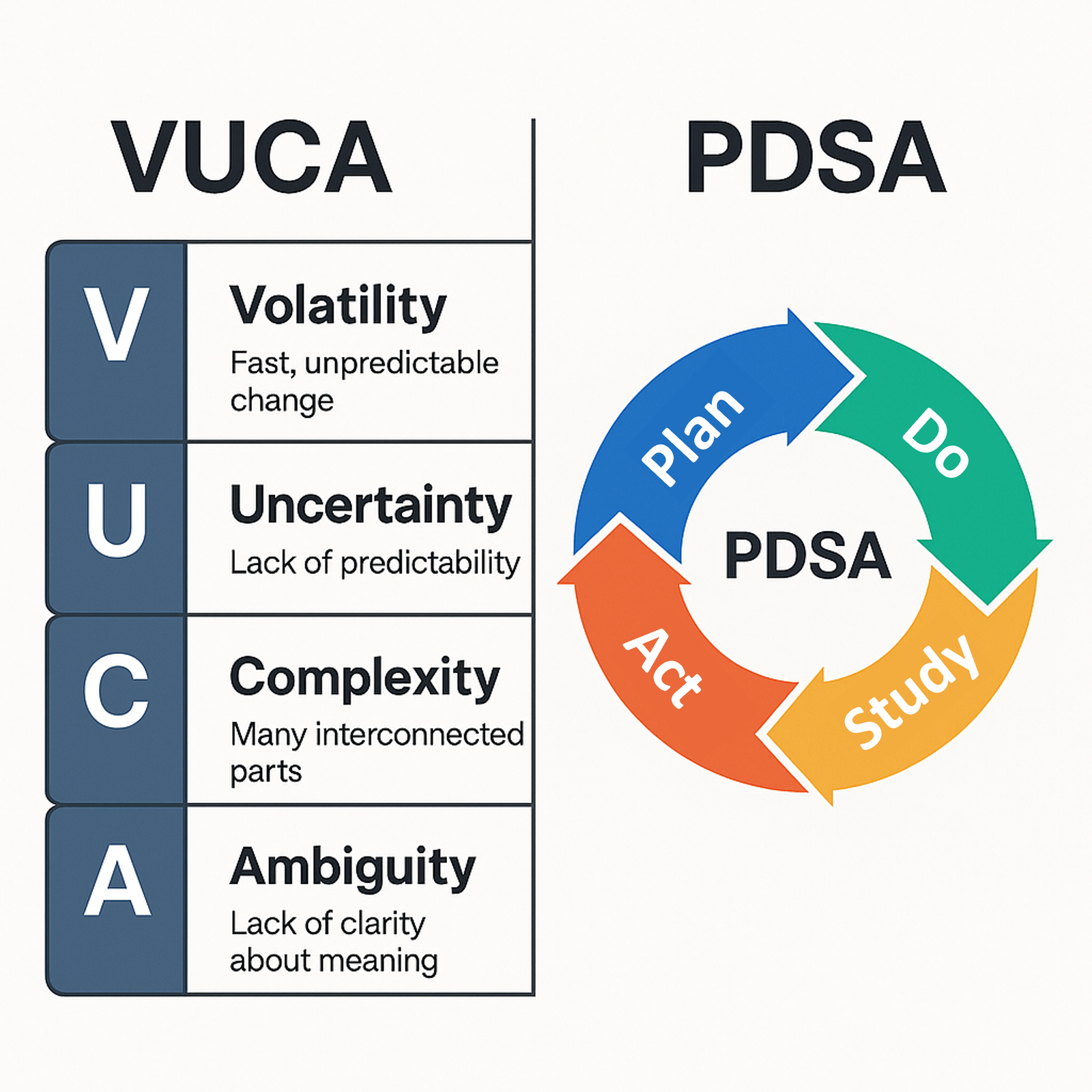
We are all leading in a VUCA world; one marked by Volatility, Uncertainty, Complexity, and Ambiguity.
At the same time, leaders and teams are searching for practical methods that help them make progress without having all the answers. That’s where the PDSA cycle comes in: Plan – Do – Study – Act, a simple yet powerful approach to continuous improvement.
What many leaders don’t realize is this:
PDSA and VUCA are deeply connected.
One describes the environment.
The other provides a way to navigate it.
Let’s explore how.
A personal note: How Kolb shaped my approach to learning and leadership
My connection to continuous learning started long before I entered the world of leadership development.
It began when I graduated as a teacher in electro-engineering, stepping into a classroom filled with students who were curious, impatient, easily distracted, and eager to understand how the world worked.
Very quickly, I learned that lecturing was not enough.
Students only truly understood when they experienced, tested, reflected, and applied what they learned.
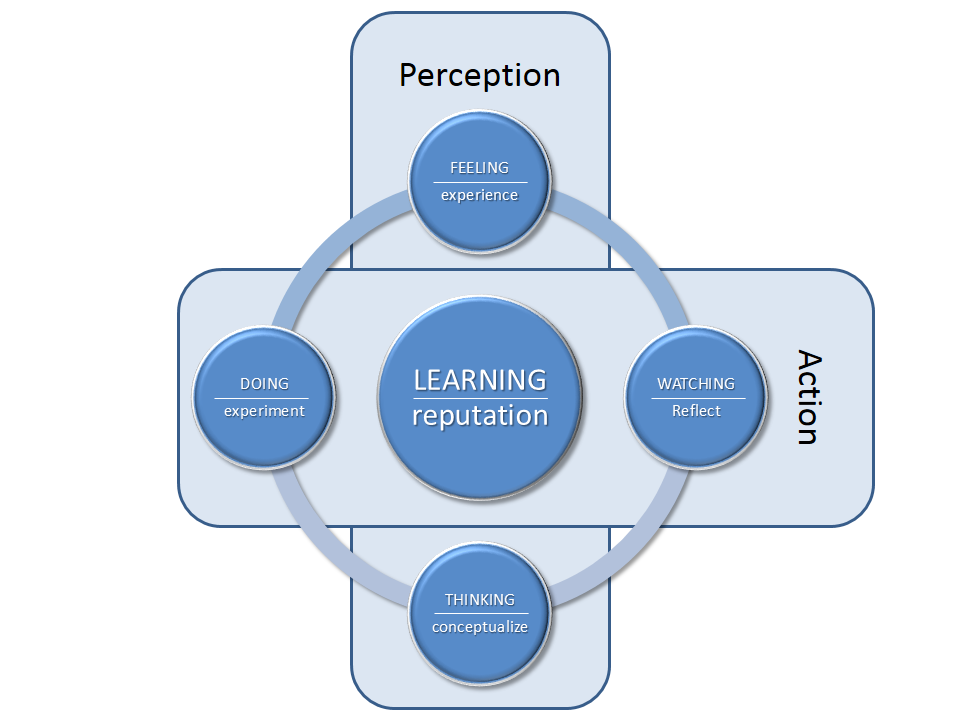
This is where I was first introduced to Kolb’s Experiential Learning Cycle, a four-step model:
- Concrete Experience
- Reflective Observation
- Abstract Conceptualisation
- Active Experimentation
Without realizing it at the time, I was already working in learning loops, creating small experiments in my teaching approach, observing what worked, adjusting, and trying again.
It was PDSA in an educational setting.
Those early years taught me something fundamental:
People learn fastest when they can experience something, reflect on it, and immediately try a better version.
Decades later, this lesson remains central in my work with leaders and teams.
Kolb gave me the mindset.
PDSA gave me the structure.
VUCA gives us the context.
And in today’s world, we need all three.
VUCA: the leadership challenge of our time
VUCA isn’t just jargon. It describes what leaders experience every day:
- Volatility: Rapid, unpredictable change
- Uncertainty: The absence of clear answers
- Complexity: Many moving parts influencing each other
- Ambiguity: No single “right” solution; multiple interpretations possible
In such an environment, classic linear planning becomes fragile. Large-scale solutions take too long. Leaders can no longer rely on experience alone, because yesterday’s patterns don’t always repeat themselves.
To lead effectively, we need new ways of thinking, and new ways of learning.
PDSA: A simple method for making progress in uncertain times
The PDSA cycle invites leaders and teams to work in small, fast learning loops:
- Plan: Define the goal and design a small test
- Do: Execute on a limited scale
- Study: Reflect on the results and learn
- Act: Adapt, adopt, or abandon — then repeat
Instead of committing to massive, risky initiatives, PDSA builds progress through experimentation, reflection, and adjustment.
This rhythm fits the reality of VUCA perfectly.
How PDSA responds to VUCA — directly and practically
Here’s where the two frameworks meet:
1. Volatility → PDSA stabilises through shorter cycles
When the world shifts quickly, yearly plans become outdated in weeks.
PDSA keeps teams flexible by working in short learning loops.
You adjust as the environment changes, instead of being paralysed by outdated plans.
2. Uncertainty → PDSA reduces guessing
In unclear situations, people often assume, debate, or postpone decisions.
PDSA replaces debate with data — even if it’s small-scale data.
A short experiment reveals more than hours of discussion.
3. Complexity → PDSA breaks it down
Complex systems overwhelm. Everything is connected to everything.
PDSA isolates one change at a time so teams can see what truly works.
4. Ambiguity → PDSA encourages curiosity
When there is no obvious solution, the safest path is exploration.
PDSA gives teams permission to test, learn, and adjust — without needing certainty upfront.
In this way, PDSA becomes a practical leadership behaviour, not just a process improvement tool.
PDSA Builds the Leadership Skills VUCA Demands
Working with PDSA develops essential leadership capabilities:
- Comfort with not knowing
- Experimentation instead of control
- Reflective, data-driven decision-making
- Psychological safety for learning and failure
- System awareness and critical thinking
And for me personally, it connects straight back to Kolb:
experience → reflection → insight → new action.
This is how people grow.
This is how teams mature.
This is how organisations adapt.
The Real Connection: Learning Faster Than the Environment Changes
When you combine VUCA and PDSA, one insight becomes clear:
In a VUCA world, the most competitive organisations are the ones that learn faster than their environment changes.
PDSA creates that learning cadence.
VUCA demands it.
Kolb explains why it works at a human level.
Together, they form a powerful leadership framework:
- VUCA raises awareness of the environment.
- PDSA offers a disciplined way to respond.
- Kolb explains how people internalise and apply the learning.
This is where transformation truly begins — not through big designs and perfect plans, but through a continuous cycle of experimenting, learning, and adjusting.
In Summary
VUCA is the challenge. PDSA is one of the most effective responses. Kolb shows how learning becomes behaviour.
Leaders who understand all three — and who teach their teams to work in continuous learning loops — build resilience, adaptability, and momentum in even the most unpredictable environments.
They don’t wait for clarity. They create it.