Managing Across Cultures: The Hofstede Playbook for Executives
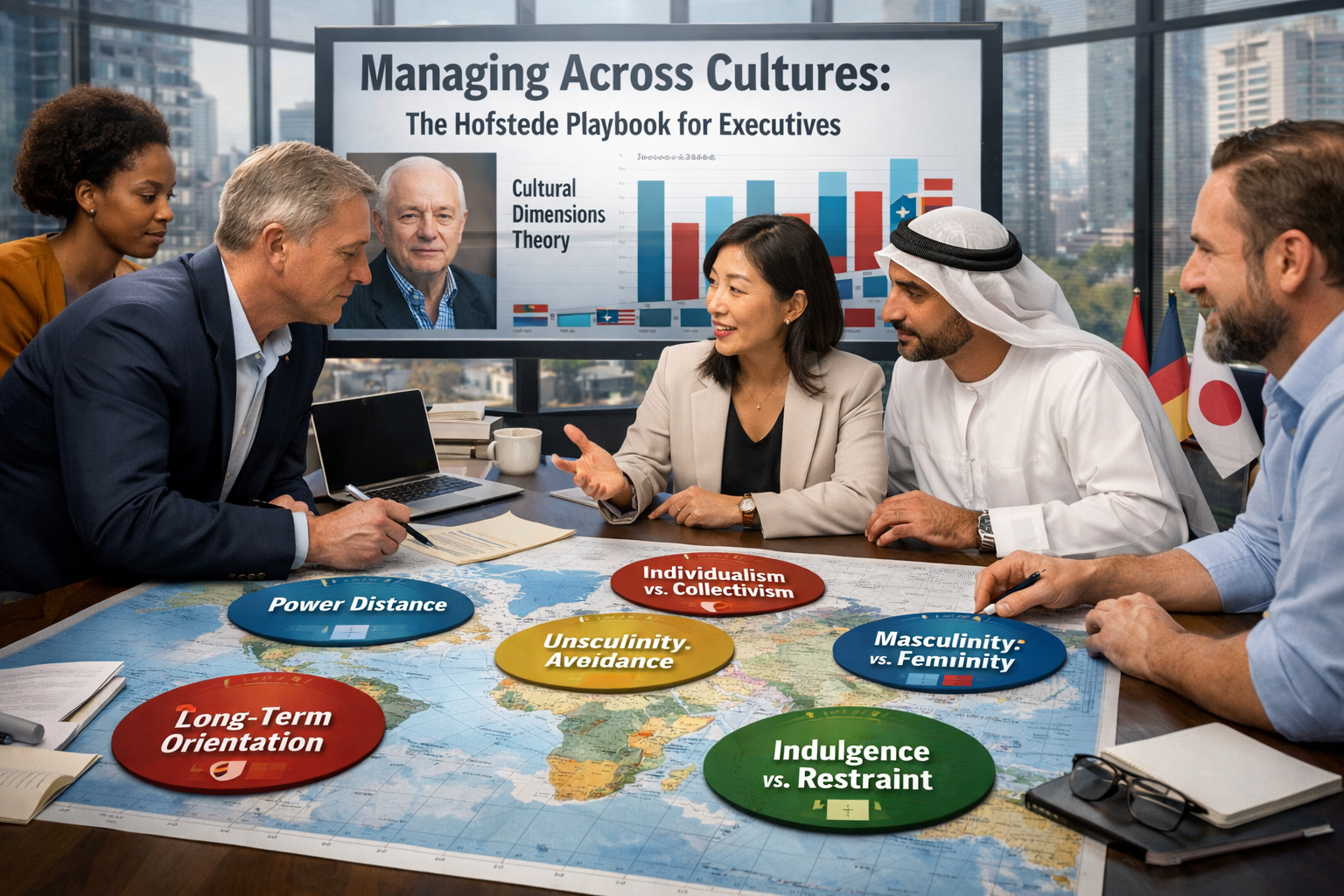
Every manager who has ever led a multicultural team, negotiated across borders, or tried to implement a global strategy knows the same unsettling truth: what works brilliantly in Amsterdam fails silently in Singapore, and what earns trust in Mexico City earns suspicion in Stockholm. Culture is not decoration. It is the operating system beneath every professional interaction, and most leaders never learned to read it.
Geert Hofstede spent the better part of his career at IBM giving us the most comprehensive empirically grounded tool we have to do exactly that. His cultural dimensions model, developed from surveys of over 100,000 IBM employees across 50 countries in the 1970s and subsequently extended through decades of follow-on research, offers executives a structured way to anticipate how culture shapes behaviour in the workplace. It is not a perfect theory. No theory of human complexity is. But it is the most actionable one available, and it remains profoundly underused in day-to-day management practice.
This article cuts through the academic abstraction and gives you a working manager’s guide: what each dimension means in practice, where it bites hardest, and precisely what to do about it.
“Culture is more often a source of conflict than of synergy. Cultural differences are a nuisance at best and often a disaster.” — Geert Hofstede
The Six Dimensions: A Practitioner’s Map
Hofstede originally identified four dimensions; a fifth was added following research with Michael Bond on Confucian dynamism; a sixth — Indulgence versus Restraint — was incorporated in the 2010 revision with Michael Minkov. Together they describe the deep-level cultural programming that shapes how people relate to authority, ambiguity, achievement, time, and pleasure. Here is how each dimension manifests in organisational life — and what to do with that knowledge.
1. Power Distance Index (PDI)
The degree to which less powerful members of society accept and expect that power is distributed unequally. Spectrum: Low PDI (Netherlands, Denmark) → High PDI (Malaysia, Philippines)
In high Power Distance cultures, hierarchy is not merely a structural convenience, it is morally expected. Employees do not question the boss; they wait for direction. Feedback flows down, rarely up. Silence in a meeting is deference, not agreement. Decision authority concentrates at the top and is seldom delegated. In contrast, low PDI cultures treat hierarchy as a pragmatic necessity. Subordinates expect to be consulted, will challenge the manager directly, and interpret excessive formality as insecurity rather than authority.
The organizational collision is predictable: a Dutch manager who runs an open, participatory team meeting — expecting pushback and challenge — may interpret the respectful silence of a Filipino colleague as passive disengagement. The colleague is, in fact, demonstrating appropriate deference. Neither is wrong. Both are confused.
Manager’s Playbook — Power Distance
In high-PDI environments, state your expectations and decisions upfront. Ambiguity is not empowering here, it is destabilizing. Authority left undefined creates anxiety, not autonomy.
If you need genuine input from high-PDI team members, create structured private channels, anonymous surveys, one-to-one sessions, written submissions, rather than expecting public challenge in a group setting.
When managing low-PDI employees, explain your reasoning, not just your conclusions. They need to know you are worth listening to before they will follow.
Adapt your feedback style: direct critique to a low-PDI employee is motivating; the same directness delivered to a high-PDI employee in front of peers is not corrective — it is damaging and relationship-ending.
When entering a new cultural context, spend time mapping the real hierarchy. Informal power structures in high-PDI cultures often deviate significantly from the org chart.
2. Individualism vs. Collectivism (IDV)
The extent to which people define themselves primarily as individuals or as members of a group. Spectrum: Collectivist (China, Indonesia) → Individualist (USA, UK)
Individualist cultures prioritise personal achievement, autonomy, and the direct expression of opinion. Collective cultures prioritise group harmony, loyalty to the in-group, and the avoidance of actions that would cause a colleague to lose face. This dimension runs deeper than team dynamics — it shapes how contracts are understood, how loyalty to an employer is calibrated, and whether speaking up is seen as professional courage or social aggression.
The trap for Western executives in collective cultures is the assumption that silence means consent, that a signed contract means alignment, and that one-to-one commitment generalises to group buy-in. None of these hold. Equally, collectivist managers in individualist environments often underestimate how little in-group loyalty binds employees to a team — people will leave for a better offer without any sense of betrayal.
Manager’s Playbook — Individualism / Collectivism
In collectivist cultures, invest time building genuine relationships before attempting to transact. Trust is personal, not institutional. A contract without a relationship is fragile.
Recognise and reward team achievements publicly in collective cultures. Singling out an individual for praise can embarrass rather than motivate.
In individualist cultures, make performance metrics, expectations, and career paths explicit and individually owned. Collective accountability diffuses responsibility and frustrates high performers.
When managing collective-culture employees in an individualist organisation, build in-group rituals — team lunches, group recognitions, shared ceremonies — that create genuine belonging.
Never deliver critical feedback to a collectivist employee in a group setting. Public criticism is not a corrective — it is a wound that outlasts the conversation.
3. Masculinity vs. Femininity (MAS)
The degree to which a culture values achievement and assertiveness over cooperation and quality of life. Spectrum: Feminine (Sweden, Norway) → Masculine (Japan, Hungary)
Hofstede’s terminology here is unfortunate — not because the dimension is invalid, but because the labels distract from what is being measured. This dimension is really about whether a culture values competition and material success (masculine pole) or cooperation and quality of life (feminine pole). In masculine cultures, work is central to identity; status symbols matter; winning is the point. In feminine cultures, work is a means to a good life; consensus and wellbeing are genuine organisational values, not HR slogans.
The executive mistake in masculine cultures is underestimating how much drive and status-seeking motivate behaviour. The mistake in feminine cultures is the reverse: importing aggressive, winner-takes-all leadership styles that read as bullying rather than ambition, or treating a genuine desire for work-life balance as lack of commitment.
Manager’s Playbook — Masculinity / Femininity
In masculine cultures, make performance visible — leaderboards, public recognition, clear advancement tracks. People are motivated by the signal that winning is possible and that their wins will be seen.
Conflict in masculine cultures is often direct and competitive; do not interpret argument as hostility — it can be a sign of genuine engagement. In feminine cultures, surface harmony may mask unresolved tension; probe carefully.
In feminine cultures, invest genuinely in work-life balance and psychological safety. These are not costs to minimise but features that attract and retain top talent.
Adjust your negotiation style: assertive, outcome-focused negotiation is respected in masculine cultures; the same approach reads as aggressive in feminine ones. Lead with relationship and shared interest.
Review whether your performance management framework was designed for masculine norms. Most global corporate systems were — which systematically disadvantages talent from feminine cultures.
4. Uncertainty Avoidance Index (UAI)
The extent to which members of a culture feel threatened by ambiguous or unknown situations. Spectrum: Weak UAI (Singapore, Jamaica) → Strong UAI (Greece, Portugal)
Uncertainty Avoidance is perhaps the most consequential dimension for how organisations actually function. High UAI cultures invest heavily in rules, procedures, and structures precisely because they provide protection against the anxiety of the unknown. These cultures produce detailed contracts, elaborate compliance frameworks, and employees who do not move without clear instructions. Low UAI cultures are more comfortable improvising — they see rules as bureaucratic friction and value agility over predictability.
The collision happens in change management. A leader with a low UAI background who rolls out change with a vision statement and an inspiring slide deck will leave high-UAI employees paralysed — not resistant, but genuinely unable to act without the detail they need to feel safe. Conversely, prescribing every step of a process feels suffocating to a low-UAI team that wants room to navigate.
Manager’s Playbook — Uncertainty Avoidance
For high-UAI teams, over-communicate structure during change: detailed implementation plans, clear timelines, explicit role definitions, and FAQ documents — not to infantilise your team, but to eliminate the ambiguity that creates paralysis.
Introduce change incrementally in high-UAI environments. Piloting new approaches and demonstrating reliability before scaling reduces resistance more effectively than mandates.
For low-UAI teams, resist the urge to prescribe the how when you only need to define the what. Give the brief, set the outcome, and let them navigate. Micromanagement in a low-UAI culture destroys morale.
Be cautious about projecting your own UAI onto others: a high-UAI manager who documents everything in writing is seen as thorough in Greece and as distrustful in Singapore.
In cross-cultural negotiations, build explicit agreement on process before addressing substance. High-UAI counterparts need the procedural container before they can engage comfortably with the content.
5. Long-Term vs. Short-Term Orientation (LTO)
The extent to which a society maintains links to its own past while dealing with the challenges of the present and future. Spectrum: Short-Term (USA, Nigeria) → Long-Term (China, Japan)
Long-Term Orientation is where East Asian business cultures most visibly diverge from Western norms. In high-LTO cultures — China, South Korea, Japan — relationships are investments, patience is a competitive advantage, and current sacrifice for future gain is rational rather than misguided. Low-LTO cultures — including much of the Anglo-Saxon world — are calibrated to near-term results, quarterly metrics, and the demonstration of value within a reporting cycle.
The management consequence: a Western executive who expects a Chinese partner to move quickly toward a commercial agreement is misreading the situation. The relationship-building phase is not a preamble to the real business — it is the business, the due diligence that determines whether any subsequent agreement will hold.
Manager’s Playbook — Long-Term Orientation
In high-LTO cultures, invest in relationship capital before you need it. The executive who arrives only when they need something has already lost the negotiation.
Adapt your planning horizons: when managing long-term-oriented teams, create multi-year roadmaps alongside shorter-cycle milestones. Quarterly-only thinking signals short-termism that undermines trust.
In short-LTO environments, make the long-term case explicitly — link immediate actions to future outcomes. The business case cannot assume that the long game is self-evidently worth playing.
When building partnerships in long-term-oriented cultures, send senior, consistent relationship managers. Rotating account managers every eighteen months destroys the relationship capital that took years to build.
6. Indulgence vs. Restraint (IVR)
The extent to which people try to control their desires and impulses, based on the way they were raised. Spectrum: Restrained (Russia, Eastern Europe) → Indulgent (Latin America, Anglo)
The sixth dimension is the least discussed and the most misread. Indulgent cultures permit relatively free expression of desires, emotions, and enjoyment. People work hard and play hard; positivity is normal and expected; leisure is a genuine value. Restrained cultures suppress gratification through strict social norms — there is a sense that life is a matter of duty, that excessive happiness is suspect, and that formal, controlled behaviour is the appropriate register for professional life.
The managerial error in restrained cultures is to interpret professional seriousness and emotional control as disengagement. A Russian or Eastern European team that does not express enthusiasm about a new initiative is not necessarily resistant — they may simply be operating in a cultural register where excessive positivity is viewed as shallow or dishonest.
Manager’s Playbook — Indulgence / Restraint
Do not impose indulgent-culture engagement programmes — team celebrations, happiness scores, mandatory socials — on restrained-culture teams. They will experience these as infantilising, not motivating.
In indulgent cultures, fun, autonomy, and personal expression are genuine motivators. Flexible working, celebration of personal milestones, and a socially positive environment are powerful retention tools.
In restrained cultures, recognition should be substantive and professional rather than effusive. A quiet acknowledgement of quality work lands better than a public celebration that embarrasses.
Be careful with global engagement surveys that use indulgent-culture baselines. A score of 65% on “I enjoy coming to work” from a Russian team may represent genuine engagement; the same score from a Brazilian team may signal a problem.
Five Principles for the Culturally Intelligent Executive
1 — Diagnose before you manage Before leading a new cultural context, invest time in understanding where it sits on the dimensions most relevant to your immediate challenge. Use the Hofstede scores as a starting hypothesis — then test against what you observe. The model gives you questions to ask, not answers to apply.
2 — Adjust the method, not the standard Cultural adaptation is not the same as abandoning your expectations. You can maintain a clear performance standard while delivering feedback in a culturally appropriate way. You can insist on accountability while building it through a structure that respects hierarchy. The standard is non-negotiable. The method of communicating and enforcing it is infinitely adaptable.
3 — Build psychological safety across the spectrum Psychological safety — the belief that one can speak up without fear of punishment — looks different across cultural dimensions. In a low Power Distance culture, safety is created by explicit permission to challenge authority. In a high Power Distance culture, safety is created by a leader who protects rather than exposes, who privately creates room for input without demanding public dissent. The goal is identical: a team where important information reaches decision-makers. The method is culturally calibrated.
4 — Make cultural assumptions visible The most powerful intervention a culturally intelligent leader can make is to surface assumptions in the moment. When a multicultural team hits friction — a misunderstood silence, a negotiation that stalled, a decision that was resisted — name the cultural dimension at play. Not as an accusation, but as data: “I wonder if we’re hitting a difference in how we think about hierarchy here.” Making the invisible visible converts cultural friction into cultural learning.
5 — Use the model to ask better questions, not to foreclose them Hofstede’s model is a population-level tool, not a person-level predictor. The Dutch employee who defers to authority and the Filipino executive who runs a flat, collaborative team both exist — and neither is a statistical error. Cultural dimensions describe central tendencies, not individual destinies. The most dangerous misuse of Hofstede is to replace genuine curiosity about a person with a cultural assumption about their country.
“The real voyage of discovery consists not in seeking new landscapes, but in having new eyes.” — Marcel Proust
Reference Summary: The Six Dimensions
| Dimension | Low Pole | High Pole | Key Management Risk |
|---|---|---|---|
| Power Distance | Flat hierarchy; challenge expected | Deference; authority unquestioned | Mistaking silence for agreement |
| Individualism | Group loyalty; collective face | Personal achievement; direct opinion | Applying one recognition model to all |
| Masculinity | Cooperation; quality of life | Competition; status; winning | Imposing competitive norms on cooperative teams |
| Uncertainty Avoidance | Comfort with ambiguity; agile | Need for structure; rule-bound | Under-specifying change in high-UAI environments |
| Long-Term Orientation | Near-term results; tradition | Persistence; future investment | Imposing quarterly thinking on long-cycle cultures |
| Indulgence | Restraint; formality; duty | Gratification; optimism; informality | Misreading enthusiasm or seriousness as engagement signals |
See the convergence in the data
This article argues that the strongest cross-cultural management insights are the ones supported by multiple independent frameworks — not just Hofstede, but GLOBE, Trompenaars, and Hall pointing in the same direction.
The Cross-Cultural Leadership Compass lets you test that convergence on any country pair you choose. The tool runs both Hofstede’s six dimensions and GLOBE’s nine societal practice dimensions simultaneously, and includes a dedicated cross-framework view that shows you where both studies agree — and flags the dimensions where they diverge, so you know where to apply more caution. It is the only freely available executive tool that brings both datasets into a single comparison.
Select your two countries, see the evidence, and take the management implications into your next brief.