The Crucial First Decision: Are You Solving the Right Problem?

Executive summary
Experienced executives often rely on pattern recognition to make decisions quickly. While valuable, this can lead them to define problems too narrowly and commit to solutions prematurely.
Professor Kuno Huisman’s work on Decision Quality offers a more disciplined approach. It involves questioning the problem definition, considering meaningful alternatives, distinguishing evidence from assumptions and evaluating decisions independently of their outcomes. Reflecting on the European Express Market Benchmark I led at TNT Express, I recognised how much of this thinking we were already applying, without knowing the formal methodology.
When a familiar question no longer produces useful answers
During my years at TNT Express, I was responsible for the European Express Market Benchmark, a competitive benchmarking exercise we conducted every two years. Its purpose was to understand how our European road network performed against major competitors and identify opportunities to strengthen our competitive position.
Earlier studies had concentrated heavily on transit times, understandably so in a business where speed was an essential part of the customer proposition. Yet when preparing a new benchmark in 2012, we confronted an important limitation. Previous analyses had shown relatively small differences in road transit speeds across much of continental Europe’s core network. Where competitors appeared significantly faster, the explanation was sometimes that shipments travelled by air rather than road. We sometimes did the same. At the same time we had next-day services, usually an air service. We utilised our road network for these services, making them highly compatible cost-wise whilst still making excellent profits.
We could have invested considerable resources in producing another, even more detailed comparison of transit times. The analysis might have been thorough, statistically convincing and visually impressive. But would it have helped us make better decisions?
That question changed our approach.
Rather than asking primarily how our transit times compared with those of competitors, we needed to understand which aspects of network performance genuinely influenced customer preferences. We also needed to identify meaningful competitive differences and determine which ones our operations could realistically address.
Our 2012 business case consequently proposed a broader approach. Customer feedback, existing competitor intelligence and operational performance indicators would help determine our research priorities. Coverage, cost, quality, reliability, flexibility and service portfolio all became relevant dimensions. Equally important, we explicitly acknowledged the limitations of competitive information. Comparing complex transport networks requires assumptions about processes and capabilities. However, we cannot always observe these directly. Aggregated industry data may conceal important differences, while apparently comparable performance figures can reflect fundamentally different operating models.
The benchmarking programme ultimately produced extensive country-level comparisons and European management reports. Looking back, however, I believe the most important contribution was not the amount of information collected. Instead, it was our willingness to reconsider what we were trying to understand before committing resources to further analysis.
“You can measure performance with great precision and still miss the decision that matters.”
Jan Salomons
What a conversation at ASML made me recognise
In March 2026, a conversation with Professor Kuno Huisman brought that TNT experience back to mind.
Kuno and I both work at ASML, although our professional backgrounds are quite different. We also share something else: alongside our ASML responsibilities, we each dedicate one day a week to a different professional activity. Kuno is a professor of Decision Making under Uncertainty at Tilburg University. Meanwhile, I spend that time conducting leadership workshops and coaching executives.
Kuno approaches uncertainty through operations research, decision analysis and economic theory. My perspective comes from operational leadership, organisational transformation and more than two decades of leadership coaching. Despite these different starting points, our work addresses a closely related challenge. How can leaders make sound decisions when information is incomplete and the future cannot be predicted with certainty?
One approach Kuno applies is the Decision Quality (DQ) framework. It originates from the Stanford tradition of decision analysis. The framework identifies six interconnected requirements for a high-quality decision: an appropriate frame, creative and meaningful alternatives, relevant and reliable information, clear values and trade-offs, sound reasoning, and commitment to action.
The framework’s underlying principle is particularly relevant to executive leadership. Decision quality depends on the strength of the decision-making process, not simply on the eventual outcome.
This distinction is more important than it may initially appear.
People frequently evaluate executives retrospectively. They interpret a successful investment as evidence of strategic foresight, while treating an unsuccessful one as proof of poor judgement. Yet executives make decisions with incomplete information, competing priorities and uncertain future developments. A sound decision can produce a disappointing outcome, just as a poorly considered decision can succeed through favourable circumstances.
Research by Jonathan Baron and John Hershey (1988) demonstrated this outcome bias, showing how knowledge of an outcome influences people’s evaluations of the decision that preceded it.
Recognising this distinction changes how executives should assess their judgement. Rather than asking only whether a decision worked, they should examine whether they framed the problem appropriately. They should also consider whether meaningful alternatives were considered, assumptions were transparent and the reasoning was defensible given what was known at the time.
Why experience can become an obstacle to better decisions
What struck me most about Huisman’s approach was how closely several principles corresponded to our thinking behind the TNT benchmark. We questioned the original frame and reconsidered which information was relevant. We distinguished observable competitor performance from assumptions and sought to connect our conclusions to operational decisions.
At the time, I was not familiar with the formal Decision Quality framework. Nor would I claim that we systematically applied all six requirements. Nevertheless, the experience illustrates how analytical discipline can emerge from operational necessity. This can happen even without an explicit theoretical foundation.
It also highlights a recurring challenge in executive leadership.
Experience improves our ability to recognise patterns, interpret incomplete information and respond quickly. These capabilities are essential, particularly in complex operational environments. However, they introduce a less obvious risk. Experienced leaders may become increasingly confident in their interpretation of a situation precisely because it resembles something they have encountered before.
Kahneman and Klein (2009) examined when people can trust expert intuition. Their work suggests intuition is especially valuable in environments with predictable patterns and opportunities to learn from feedback. Where these conditions are absent, confidence can exceed actual judgement accuracy.
I regularly encounter this tension in executive coaching and leadership-team discussions. A problem is presented, someone recognises a familiar pattern, and a plausible solution quickly emerges. The conversation then moves towards implementation, resources and accountability. What receives less attention is whether the initial interpretation was correct.
The collective experience of a management team can reinforce this tendency, particularly when senior members share similar professional backgrounds or organisational histories.
This is not an argument against experience or intuition. The challenge is to recognise when they deserve to be questioned.
Here, I see an important connection between decision analysis and leadership development. The Decision Quality framework provides a structure for examining decisions. Leadership capability determines whether executives can use that structure effectively. This matters especially when doing so requires questioning established assumptions, challenging a senior colleague or admitting that the organisation does not yet understand the problem.
A methodology can require an appropriate frame. It cannot, by itself, guarantee that a leadership team will have the openness and discipline to reconsider a frame to which it has already become committed.
Deciding when to act, and when to wait
Huisman’s academic work adds another important dimension: the timing of decisions under uncertainty.
In his book Technology Investment: A Game Theoretic Real Options Approach (2001), Huisman examines investment decisions through real options theory. He also explores them through game theory. His 2017 inaugural lecture, Besluitvorming onder onzekerheid, further establishes decision-making under uncertainty as the central subject of his academic work.
One implication is particularly relevant to executives. When uncertainty is significant, retaining the flexibility to act later may have economic value. However, delaying a decision also carries costs, including missed opportunities and competitive disadvantages. The challenge is not simply to gather more information. Executives must understand which information could change the decision and whether waiting for it is justified.
This introduces a distinction that many organisations struggle with. Some information is missing and can be collected. Other information concerns future developments that we cannot yet know. Treating these forms of uncertainty as interchangeable can encourage excessive analysis. It can also delay decisions without necessarily improving their quality.
We were not applying real options calculations during the TNT benchmark. The connection is conceptual rather than methodological. Both approaches require leaders to question whether additional information, further analysis or delayed commitment will genuinely improve the decision.
That is an important discipline in environments characterised by volatility, uncertainty, complexity and ambiguity.
Better decisions begin before the analysis
If I were to initiate the TNT benchmark again today, I would begin with one question: Which decisions do we expect to make differently because of this research?
Only after establishing that would I determine which information was necessary, what level of uncertainty was acceptable and which comparisons would provide genuine decision value.
This has implications far beyond competitive benchmarking. Organisations invest substantial resources in strategic reviews, investment proposals, transformation programmes and performance analyses. Yet people often judge the quality of these activities by the analysis’s comprehensiveness, the presentation’s sophistication or the forecast’s apparent precision.
None of these guarantees that the organisation has correctly defined the decision it needs to make.
There is also a leadership dimension that deserves greater attention. Asking teams to produce more analysis often feels responsible and relatively safe. Challenging the premise behind an established initiative can feel considerably more uncomfortable. This is particularly true when executives have already invested attention, resources and reputations.
Nevertheless, that challenge may be the most valuable contribution a senior leader can make.
My conversation with Kuno reinforced a conviction formed over many years in operational leadership. Sound decisions require both analytical rigour and the willingness to question our own judgement. Experience provides valuable insights, but it should not exempt us from examining the assumptions on which those insights rest.
Before commissioning the next major analysis, I would encourage executives to examine their starting point. Have they begun with the proposed solution, the available data or the actual decision to be made?
The sequence matters. Once someone frames a problem incorrectly, even excellent analysis can lead an organisation confidently in the wrong direction.
The quality of an executive decision often depends on what happens before anyone starts looking for the answer.
References and further reading
- Huisman, K. J. M. (2001). Technology Investment: A Game Theoretic Real Options Approach. Kluwer Academic Publishers.
- Huisman, K. (2017). Besluitvorming onder onzekerheid. Inaugural lecture, Tilburg University.
- Spetzler, C., Winter, H., & Meyer, J. (2016). Decision Quality: Value Creation from Better Business Decisions. Wiley. The requirements for decision quality.
- Baron, J., & Hershey, J. C. (1988). Outcome bias in decision evaluation. Journal of Personality and Social Psychology, 54(4), 569–579.
- Kahneman, D., & Klein, G. (2009). Conditions for intuitive expertise: A failure to disagree. American Psychologist, 64(6), 515–526.
For another perspective on leadership judgement, read How decision-making impacts team performance.
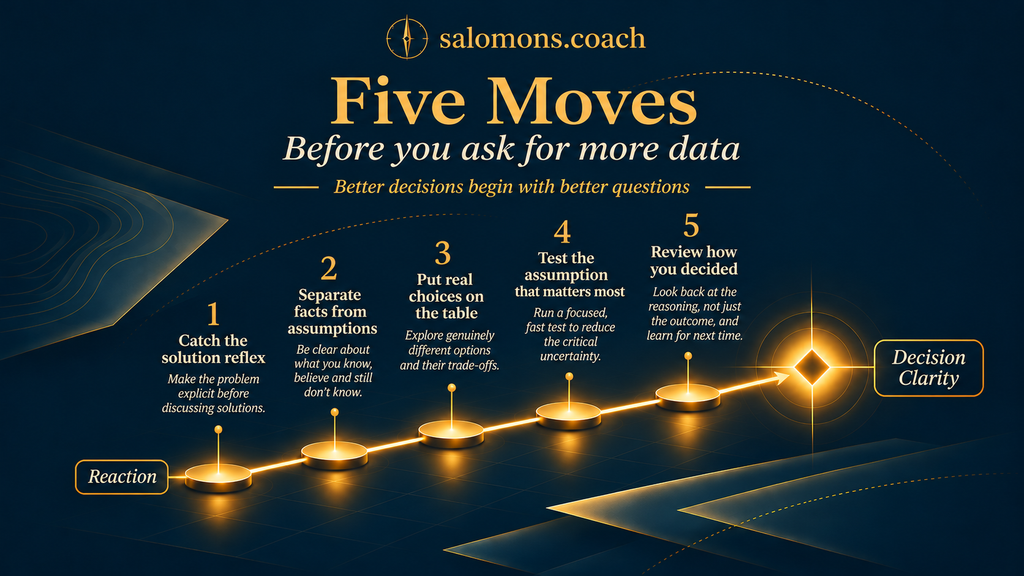
From insight to action: Five Moves
Understanding why executives sometimes solve the wrong problem is one thing. Changing how we make decisions is another.
In my companion Five Moves series on Substack, for this blog post titled “Before you ask for more data,” I translate these principles into five practical actions you can apply in your next leadership meeting. From questioning your initial problem definition to testing critical assumptions and reviewing decision quality, the focus is on turning better thinking into better leadership decisions.

You may also like


The Ultimate Guide to the Impossible Operating Plan

New Leader, Existing Team, Team Reset