From Firefighting to Learning: The Leadership Shift Operations Need
1. Firefighting as Rational Behavior in a Complex System
A firefighting culture is not a failure of people, but a logical leadership response in a complex, time-critical system.
According to Karl Weick and his work on sensemaking, people under pressure tend to:
- respond to what is most visible and urgent,
- construct meaning from what is immediately experienced,
- act based on experience and plausibility, rather than completeness or analysis.
In high-volume, night-time operations this means:
- an incident feels more real than a trend,
- fixing feels more useful than analyzing,
- action feels safer than delay.
Firefighting is therefore functional behavior in an environment that lacks an explicit learning structure.
2. The Action Bias: Why Solving Problems Is Rewarded
Operational environments are strongly influenced by what the literature calls the action bias:
the tendency to favor action over reflection, even when reflection would be more effective.
In practice, this means:
- managers become visible and valued when they intervene,
- supervisors receive recognition when they “save the shift,”
- reflection is postponed because “the operation must continue.”
This creates an implicit reward system:
Those who solve problems are seen as good leaders.
Those who ask questions are seen as slowing things down.
This is rarely an explicit policy, it is learned behavior, reinforced every day.
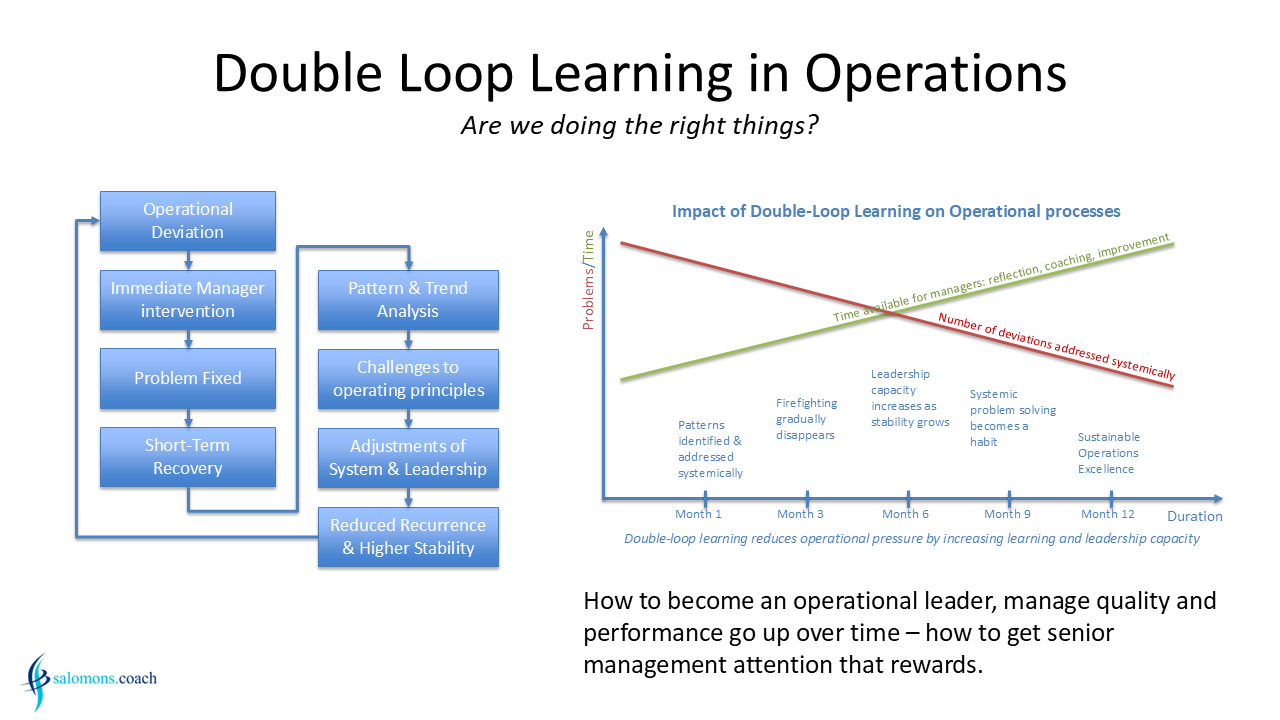
3. Single-Loop vs. Double-Loop Learning (Argyris & Schön)
Firefighting is almost always a form of single-loop learning.
- Single-loop learning:
“Fix the problem so we can move on.” - Double-loop learning:
“Why does this problem keep occurring?”
As long as leadership:
- focuses primarily on outcomes (service, volume, throughput),
- and does not explicitly steer learning from deviations,
the organization remains trapped in single-loop behavior.
Structural improvement requires leaders to create space for double-loop learning — and this does not happen automatically.
4. Lean / PDCA: Distinguishing Incidents from Patterns
Within Lean and PDCA thinking (Plan–Do–Check–Act), distinguishing the type of problem is critical.
- Ad-hoc / one-off issues
→ fix immediately, restore the standard. - Recurring / trend-based issues
→ analyze, identify root causes, adjust the system.
What often goes wrong is that:
- organizations have data,
- but lack the rhythm and discipline to use that data for pattern recognition.
As W. Edwards Deming famously stated:
“Without theory, there is no learning.”
Without an explicit learning process, data becomes decoration rather than direction.
5. The Cultural Perspective: What Leaders Make “Normal”
According to Edgar Schein, culture is shaped by:
- what leaders pay attention to,
- where they intervene,
- what they tolerate under pressure.
In a firefighting culture, employees observe that:
- escalations receive attention,
- trends receive little airtime,
- reflection is optional,
- fixing problems is mandatory.
As a result, supervisors and teams learn what is normal, regardless of what is written in policies or presentations.
6. What Structural Problem-Solving Truly Requires
Moving from firefighting to structural improvement does not require better people, but a different leadership system.
a. Organizing sensemaking
Managers help teams distinguish between:
- noise and signal,
- incidents and patterns,
- coincidence and system failure.
This requires shared interpretation, not individual experience.
b. Rhythm before analysis
Without a fixed rhythm, the operation always wins.
Effective organizations:
- explicitly schedule moments for trend review,
- use dashboards as dialogue tools,
- discuss deviations before they escalate.
Rhythm creates space for learning.
c. Adjusting leadership behavior
The critical shift is:
from “I solve the problem”
to “I ensure we learn from it”
This means:
- asking questions instead of giving solutions,
- allowing problems to wait for the right learning moment,
- making supervisors owners of analysis.
This initially feels uncomfortable, but it is essential.
7. Summary: The Underlying Theoretical Shift
The transition you are making can be summarized as follows:
| Firefighting culture | Learning system |
|---|---|
| Urgency-driven | Rhythm-driven |
| Experience & intuition | Experience + data |
| Incident focus | Pattern focus |
| Fixing = success | Learning = success |
| Individual action | Collective leadership |
Conclusion and how to move forward
Organizations do not automatically learn to distinguish between:
- a one-off problem that must be fixed, and
- a structural pattern that requires leadership attention.
That distinction only emerges when:
- managers explicitly create space for learning,
- supervisors are part of the leadership system,
- leadership behavior is more consistent than the pressure of the shift.
This is not a tooling issue.
It is leadership in action.

You may also like
Five Steps to Take Immediate Control of a Crisis
Most Leadership Teams Lack Dialogue