Evidence-Based Impact of Coaching: What the Most Reliable Studies Show
Executive summary
Executive coaching produces its most valuable effects when insight translates into observable changes in behaviour. Self-awareness alone does not guarantee stronger leadership, and positive participant feedback is not the same as business impact.
This article examines research on coaching and the stages through which development can influence workplace practice. It encourages organisations to connect coaching goals to real leadership challenges, gather evidence of changed behaviour and distinguish plausible outcomes from exaggerated causal claims. The investment case becomes stronger when progress is assessed against relevant expectations over time, rather than resting on testimonials or a single return-on-investment figure.
LinkedIn Post.
The two most robust academic sources on coaching, a broad meta-analysis of coaching outcomes (Jones, Woods & Guillaume, 2016) and a 2023 meta-analysis based exclusively on randomized controlled trials (RCTs), show a consistent, measurable pattern:
1. Coaching reliably improves performance, well-being, skills, and leadership behavior.
Across both studies:
Performance
- Effect size 0.29–0.36, meaning in business terms: A measurable improvement in job performance, decision-making, stakeholder handling, and execution. Comparable to other effective leadership development interventions.
Skills & Competencies
- Effect size 0.43–0.46, meaning in business terms: Leaders get better at leading, communication, delegation, prioritization, emotional intelligence, and political navigation all improve at levels considered moderate and practically significant.
Well-being & Resilience
- Effect size 0.37–0.46, meaning in business terms: Reduced stress, better coping with pressure, improved emotional regulation, all of which protect performance and reduce the likelihood of burnout or disengagement.
Goal Attainment
- RCT studies show increases of 20–40%, meaning in business terms: Coaching helps leaders execute faster, meet deadlines more consistently, and deliver on strategic priorities.
2. The strongest finding across both studies: Coaching shifts the behaviors that drive business results.
Unlike training, which often fades quickly, coaching creates:
- more ownership
- more effective communication
- better handling of ambiguity
- improved alignment
- stronger stakeholder relationships
These are the enablers of performance, which makes coaching a strategic investment rather than a cost. In business terms, coaching delivers upstream improvements that lead to downstream results.
“A good coaching story can inspire. Evidence must tell us whether change actually lasted.”
Jan Salomons
3. Coaching has a stronger effect on mindset and behavior than on direct KPIs, which is exactly how leadership change works.
The RCT meta-analysis shows: skills (0.43) and well-being (0.37) improve more strongly than raw performance (0.16–0.29).
Interpretation for executives:
- Coaching strengthens the leader first.
- When the leader becomes more effective, the team and system follow.
- This effect compounds over time.
How this scientific evidence supports my 4R model
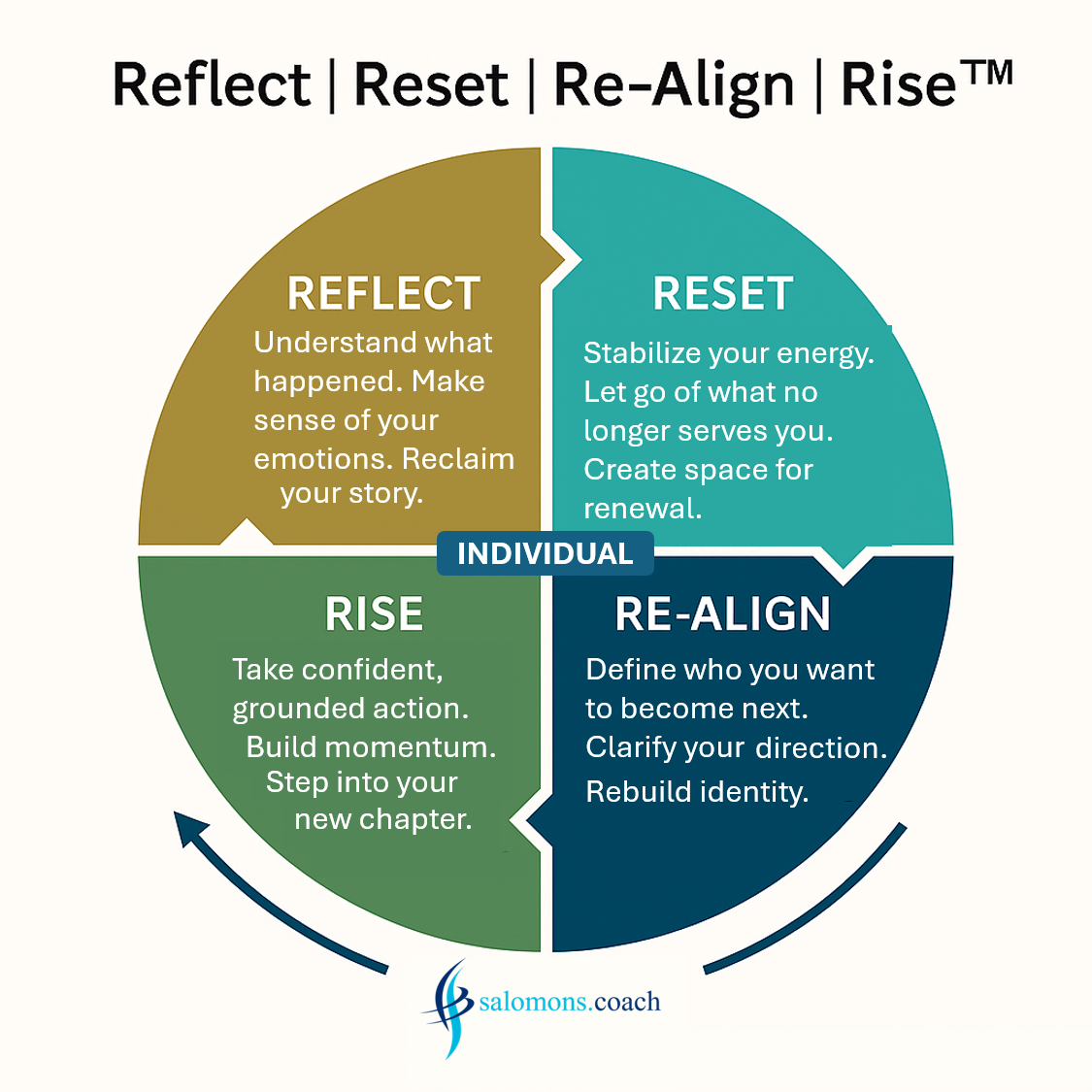
I have developed my 4R model in 2024-2025 based on the experience of both individual and team coaching sessions, in total approx. 70 sessions.
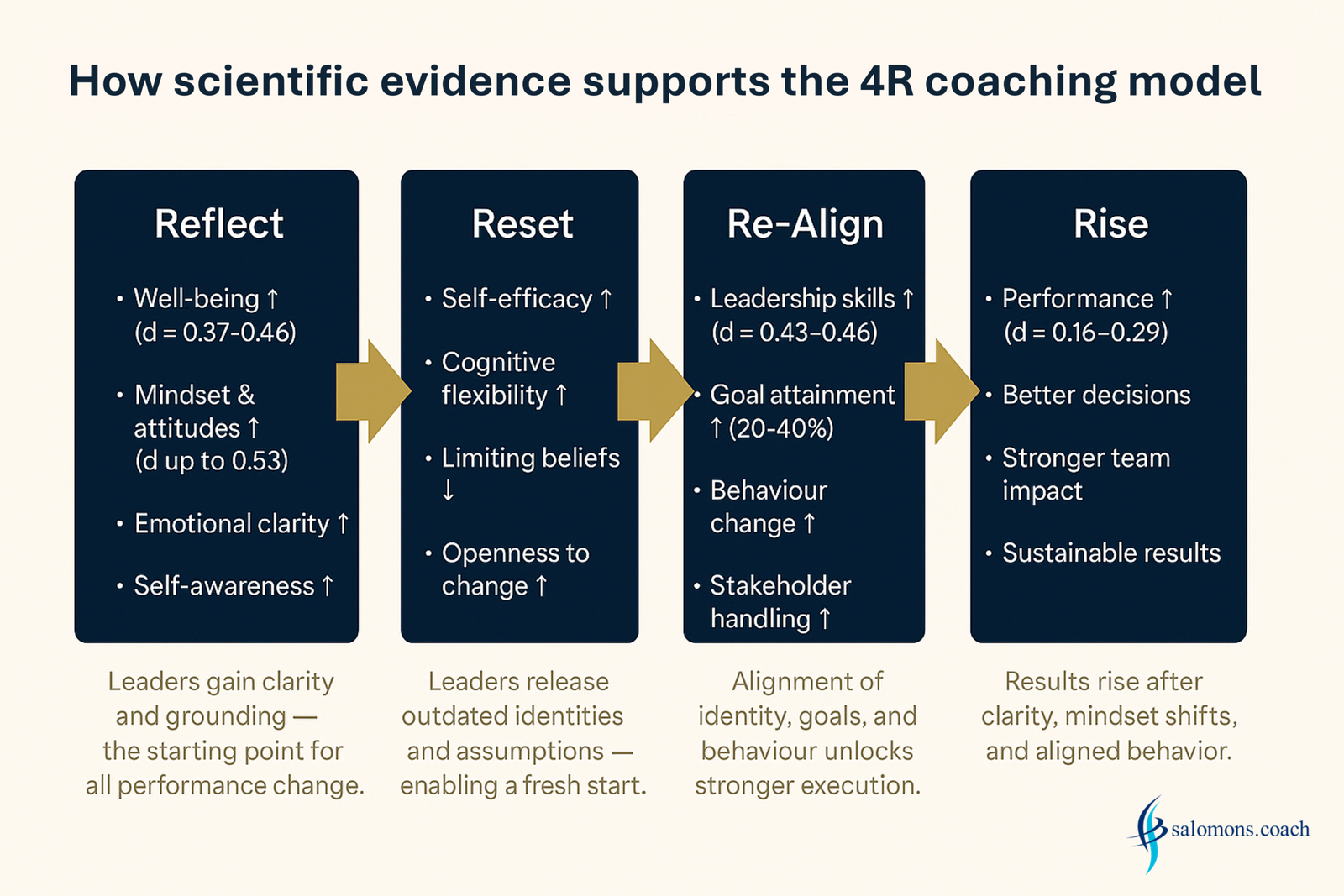
The combined findings from the two most rigorous coaching studies, the Jones, Woods & Guillaume (2016) meta-analysis and the 2023 RCT-only meta-analysis, strongly validate the structure and sequencing of my 4R Model.
Across both studies, the data shows that coaching effects unfold in a specific order, matching the four phases of your model.
1. Reflect – Coaching first improves awareness, mindset, and emotional clarity
Both meta-analyses show the largest early coaching effects occur not in performance metrics, but in:
- well-being (effect sizes 0.37–0.46)
- emotional regulation
- mindset and attitudes (0.53 in some studies)
- self-efficacy (confidence in complex situations)
Why this supports “Reflect”:
Leaders make progress fastest when they first understand:
- their emotional responses
- their identity and patterns
- their stress load
- their internal narratives
These internal shifts are empirically the first change coaching produces.
In other words:
Leaders must first Reflect before anything else can change.
2. Reset – Coaching helps leaders let go of outdated beliefs and assumptions
The academic findings show that coaching reliably strengthens:
- self-efficacy (leaders feel more capable)
- cognitive flexibility
- willingness to try new behaviors
- adaptability under pressure
These shifts represent the “unlearning” or Reset phase — letting go of:
- identity tied to old roles
- rigid beliefs about what is possible
- outdated coping strategies
- limiting narratives about value or capability
Why this supports “Reset”:
Coaching does not immediately change external results — it first loosens the internal constraints that prevent progress.
This is the psychological reset the research consistently identifies.
3. Re-Align – Coaching next improves skills, behavior, and alignment with goals
Both meta-analyses show moderate, reliable improvements in:
- leadership skills (effect sizes 0.43–0.46)
- communication and stakeholder management
- goal clarity and goal attainment (20–40% improvement)
- behaviour change observable by others
This aligns with the Re-Align phase, where leaders begin to:
- clarify their direction
- articulate a new value story
- align goals with identity
- adopt new behaviours that better fit their next chapter
Why this supports “Re-Align”:
Behavioral and skill improvements occur after mindset changes, never before.
The research confirms that alignment comes from identity clarity, not the other way around.
4. Rise – Coaching lastly improves performance and results
The studies show smaller but still significant improvements in raw performance (0.16–0.29).
This is important:
Performance increases after inner clarity, behavioral shifts, and skill development, not before.
This matches the Rise phase, where leaders:
- step back into the market with confidence
- present a coherent narrative
- execute more effectively
- navigate complexity with ease
- contribute to stronger team and organisational outcomes
Why this supports “Rise”:
Performance is an outcome, not an input.
The research shows that leaders rise when the foundational layers, Reflect, Reset, Re-Align, are in place.
The Scientific Logic Behind the 4R Model
Across the highest-quality coaching research available, a clear developmental pathway emerges:
- Internal clarity improves first (Reflect)
- Limiting beliefs loosen second (Reset)
- Behaviour and alignment shift third (Re-Align)
- Performance rises last (Rise)
This sequence is not a theoretical preference: it is exactly how coaching works in practice, and how the evidence says change occurs.
The model is therefore fully consistent with:
- psychological change theory
- adult learning theory
- identity-based behaviour change
- the empirical evidence base of coaching
4. What this means for organizations
These studies give companies clear, evidence-based insights:
- Coaching produces meaningful, measurable improvements: Not hype, not inflated ROI numbers, but credible behavioral and performance change.
- Coaching works particularly well in complex environments: Ambiguity, high pressure, political dynamics, cross-functional roles — the areas where your clients operate.
- Coaching should not be judged on immediate KPIs: It should be judged on leadership capability, which is the upstream driver of sustainable results.
- Coaching effects match or exceed most other development methods: Including classroom training, mentoring, and many corporate learning programs.
5. The combined scientific conclusion
When the most rigorous studies are brought together, the case for coaching is clear:
Coaching consistently delivers moderate, statistically significant improvements in leadership behaviour, performance, well-being, and skill development. These improvements directly strengthen the conditions under which teams and organisations achieve results.
No exaggeration. No inflated ROI stories. Just reliable, scientific evidence that coaching works.
Need coaching, schedule a free call to find out if I can be of help.

You may also like


The Ultimate Guide to the Impossible Operating Plan

New Leader, Existing Team, Team Reset