45+ and you need a new job? This is why professionals struggle more than their CV shows

(Inspired by real client insights and the Dutch job market context)
When people over 45 lose their job, whether through redundancy, reorganization or a shift in business strategy, the outside world often responds with a set of assumptions:
“You have decades of experience, you’ll be fine.”
“You’re senior, so the market will want you.”
“With your CV you’ll find something quickly.”
But the reality for many 45+ professionals in the Netherlands is very different.
Not because they lack skills, motivation or professionalism, but because the job market interprets their profile in a much narrower way than their true value represents.
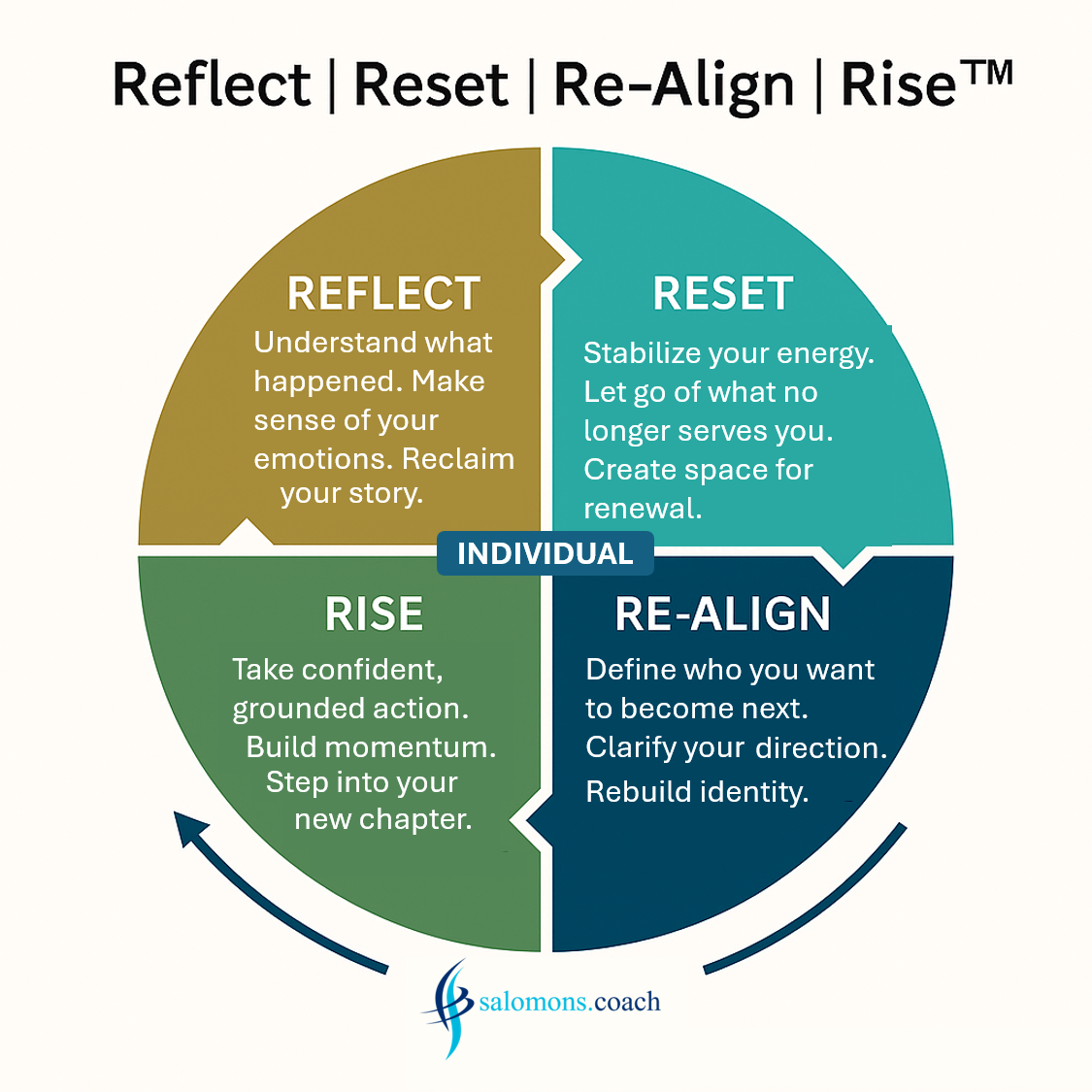
This article is the second in the follow-up series based on the powerful feedback I received from a client who moved through the 4R Model (Reflect–Reset–Re-Align–Rise™) during his redundancy journey. His experience reflects what I see again and again in practice.
Let’s unpack why 45+ professionals face unique challenges — and why none of these challenges have anything to do with capability.
First, let’s have a look at the impact of your CV.
1. Your CV is broader than recruiters can decode
Many mid-career professionals have held roles with titles such as:
- project manager
- program manager
- team lead
- operations manager
- business manager
- senior specialist
Titles that cover five to ten responsibilities in one job.
Recruiters, however, search like this:
“Project manager AND agile AND healthcare sector”
OR
“Senior engineer + specific tech stack”
The problem is structural:
Recruiter databases require tags, but 45+ careers are often too broad to tag.
You may have:
- run teams
- led change and reorganizations
- delivered and improved operations
- handled budgets
- driven strategy
- improved processes
- negotiated with stakeholders and suppliers
- created successful customer experiences
…but the database only sees the job title.
As my client shared:
“Recruiters couldn’t place me. I wasn’t ‘project manager enough’, not ‘technical enough’, not ‘program manager enough’. But I had done all of it.”
Your CV is rich. But the system is simplified. That’s the mismatch.
2. Seniority is often misinterpreted as “expensive”
This is a hard truth in the Dutch market:
Companies assume 45+ candidates want the same (or higher) salary as before.
But many professionals in transition are NOT asking for more.
They want:
- stability
- meaningful work
- balance
- a sustainable career for the next 15–20 years
- a healthy culture
As my client described:
“After 25 years of international work, I don’t need to climb higher. I want depth, impact, and a realistic lifestyle for my family.”
But the market assumes:
- high salary expectations
- high seniority needs
- ambition to climb
- unwillingness to step into a differently-shaped role
This assumption eliminates great people long before any conversation happens.
3. Over 45, you may underestimate your own value
This is perhaps the most important factor — and the most invisible one.
After a career of solving problems, being reliable, and constantly adapting, many senior professionals see their strengths as… “normal.”
But they are not normal. They are rare.
For example:
- the ability to read politics in a room
- balancing conflicting stakeholders
- running complex operations under pressure
- navigating ambiguity
- mentoring younger colleagues
- keeping things calm in chaos
- understanding the systemic consequences of decisions
These things are not in job descriptions.
But organisations deeply need them.
And yet, as my client said:
“I realised I’d been making myself smaller. I thought my broad experience was obvious. It wasn’t — until others reflected it back to me.”
45+ professionals often need help reframing their value story, not because they lack value, but because they’ve normalised it.
4. The hidden emotional layer: identity shock
Even when the redundancy is understood rationally (“it’s restructuring, not me”), the emotional shock is real.
For many senior professionals:
- work and identity have become intertwined
- leaving a long-term employer feels like leaving a part of yourself
- the job title becomes a “container” for your worth
When this container disappears, confidence drops, even among high performers.
This temporary dip leads to:
- uncertainty
- hesitation
- underselling in interviews
- accepting roles that don’t fit
- applying too broadly or too narrowly
This is why time — the insight from the previous article — is so crucial.
Identity needs space to reshape itself before a coherent career story can be told again.
5. The world of work has changed — and mid-career roles have changed with it
The Dutch labour market increasingly wants:
- specialised skills
- domain expertise
- digital proficiency
- industry-specific experience
But senior professionals have built:
- broad capability
- cross-functional thinking
- leadership maturity
- stakeholder sensibilities
- strategic execution skills
The market wants “sharply defined.”
45+ professionals often offer “professionally rich.”
That is not a weakness — it is gold.
But the hiring system isn’t always built to interpret it.
6. So what helps 45+ professionals rise stronger?
From coaching over a hundred of senior professionals and using the 4R Model, here’s what works:
Reflect: Understand the emotional and identity impact first — without rushing.
Reset: Let go of the old story:
- “I must climb.”
- “I must stay at my level.”
- “I must earn the same.”
Re-Align: Build a new narrative:
- What do you really want?
- What role fits the next chapter?
- What brings meaning now?
- What is your real value story?
Rise: Experiment, refine your story, talk to the right people, and step back into the market with clarity and calmness — not urgency.
My client’s journey demonstrates this beautifully. Once he re-aligned, he said:
“I finally saw where I fit. And everything started falling into place.”
7. This is not a 45+ problem — it’s a market interpretation problem
And it can be changed, by:
- reframing your narrative
- clarifying your identity
- mapping your transferable strengths
- widening your sector orientation
- telling your story through skills, not job titles
- lowering pressure around title and salary
- shifting to meaning, impact, and sustainability
This is where coaching makes a difference. Not because people need fixing, but because they need clarity, reflection, and a reframed identity.
Final thought
If you are over 45 and navigating redundancy or transition, remember:
You are not less valuable.
You are less “easily tagged” by a system that prefers narrow profiles.
Your depth, maturity, perspective and capability are exactly what many organisations desperately need — but only visible when you tell your story from a place of clarity rather than shock.
This is what my 4R Model helps create. Are you in a similar situation and need to have a chat or more?

You may also like


What Gets Seen, Gets Repeated – Firefighters vs Preventers
Five Steps to Take Immediate Control of a Crisis