The Executive Presenting Framework
Introduction
At senior level, your ability to present is no longer a skill set. It is leadership in public.
Every time you stand in front of a board, an executive team, or critical stakeholders, you are not simply sharing information or advocating a position. You are establishing presence, exercising judgment, and signalling authority, often under pressure, with incomplete information, and real consequences attached.
This is why truly strong presentations feel different. They do not persuade through polish or performance. They lead through clarity, composure, and direction.
In executive environments, people do not primarily evaluate what you say. They assess how you think, how you prioritize, and how you hold uncertainty. A “killer presentation” is therefore not one that gets applause or approval, but one that leaves no doubt about who is leading the thinking in the room.
Yet much of what is taught as presentation skills still treats presenting as a technique: slides, storytelling formats, delivery tricks. Useful, perhaps, but insufficient. Because at this level, presenting is not about getting what you want. It is about taking responsibility for where the conversation, the decision, and the organization go next.
The Executive Presenting Framework was developed from this reality. Not as a communication model, but as a leadership discipline, designed for executives who understand that every presentation is a moment where leadership is either established or eroded.
What follows is not advice on how to present better. It is a framework for how to lead when you present, especially in a VUCA world (Volatile, Uncertain, Complex, Ambiguous), where clarity, judgment, and presence matter more than ever. In my blog you will find quite a number of posts that take you deeper in VUCA if you are interested >> click “VUCA” in the tag-area.
The Executive Presenting Framework
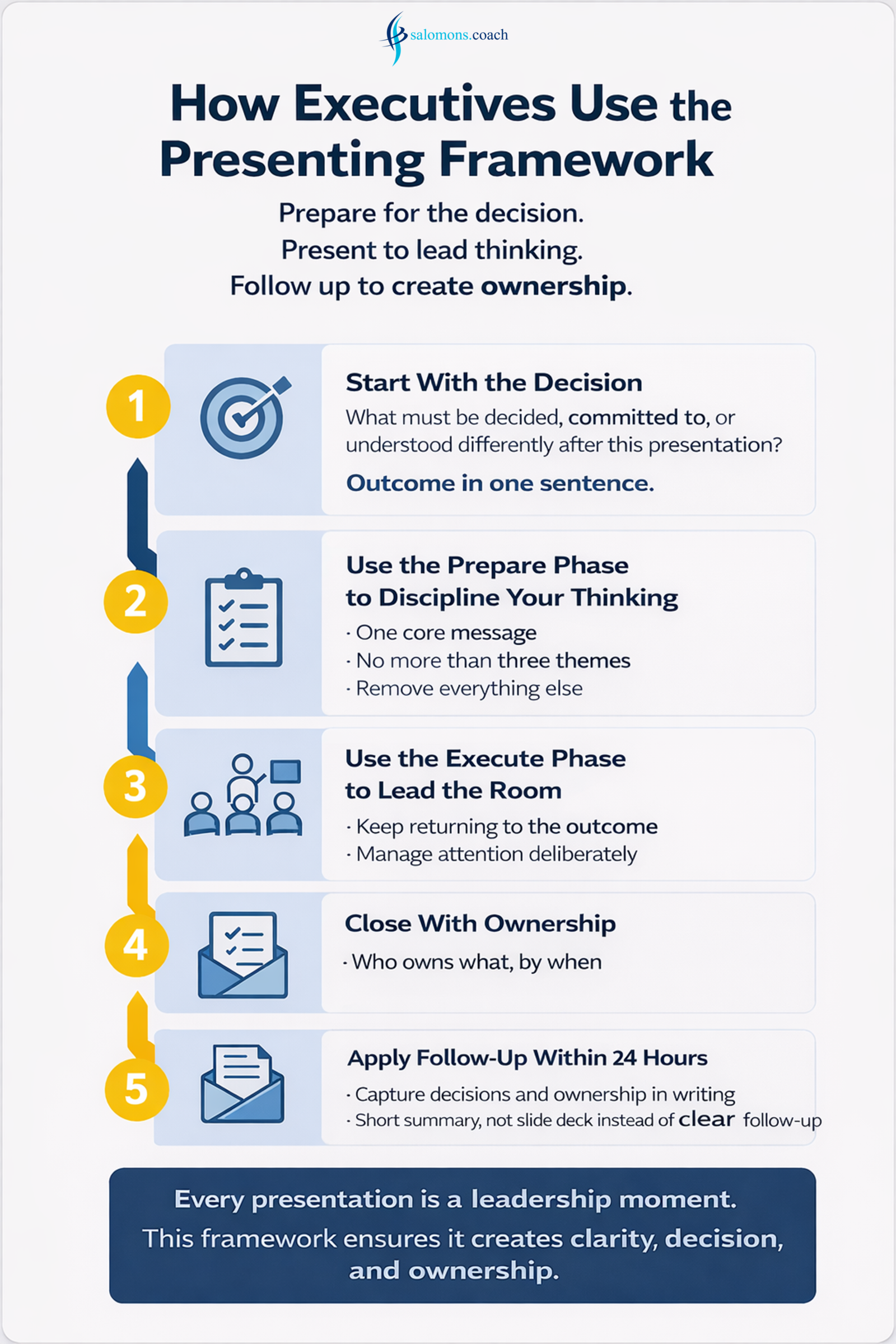
reframes presenting as a leadership discipline rather than a communication skill. It is built around a simple but powerful logic: Prepare, Execute, Follow up, that mirrors how leadership works under pressure. Leaders prepare by clarifying the decision and exercising judgment before entering the room, execute by leading the thinking through structure, presence, and deliberate trade-offs, and follow up by converting clarity into ownership and action. Grounded in human psychology and the realities of VUCA environments, the framework helps executives reduce cognitive overload, establish authority, and ensure that presentations do not end with discussion, but with direction, decision, and responsibility.
Why Great Presentations Are a Leadership Discipline in a VUCA World
In volatile, uncertain, complex, and ambiguous environments, presentations are no longer neutral communication moments. They are leadership interventions.
Every time a senior leader presents — to an executive team, a board, or critical stakeholders, judgment is tested, clarity is demanded, and ownership must become explicit. Yet most presentation advice still focuses on slides, storytelling techniques, or speaking confidence.
That focus is outdated.
The Executive Presenting Framework was developed from a simple observation:
what makes presentations effective at senior level is not polish, but how well they align human psychology with leadership responsibility under pressure.
Why Executives Need a Different Presenting Model
In VUCA and Executive’s environments:
- Information is incomplete
- Time is scarce
- Cognitive load is high
- Decisions carry real consequences
Under these conditions, the human brain does not process presentations analytically. It looks for:
- Meaning before detail
- Structure before nuance
- Judgment before data
When leaders fail to address this, presentations drift into discussion, meetings overrun, and ownership dissolves.
The Executive Presenting Framework addresses this reality directly by structuring presentations around how leaders influence outcomes before, during, and after they speak. Its core logic is deliberately simple: Prepare → Execute → Follow-up. This mirrors how leadership actually works.
Phase 1 Prepare: Lead Before You Enter the Room
Preparation is not about slides. It is about thinking clearly before asking others to decide.
1. Start With the Decision
Psychologically, the brain seeks relevance before information. If intent is unclear, attention fragments.
That is why the framework starts with one non-negotiable question: What must be decided, committed to, or understood differently after this presentation? In real executive life, many leaders unconsciously avoid this question. They present analysis and hope clarity will emerge. It rarely does.
In VUCA contexts, unframed information increases anxiety, not insight. Starting with the decision gives the audience a mental anchor that allows them to prioritize everything that follows.
2. One Core Message, Three Supporting Themes
Cognitive psychology is clear: people remember one idea, supported by a small number of patterns. The framework therefore forces leaders to:
- Distill the message to one core idea
- Limit themselves to no more than three supporting themes
This is not simplification for its own sake. It is cognitive leadership.
In complex environments, structure reduces perceived chaos. Leaders who provide structure are experienced as more credible and in control, even when uncertainty remains.
3. Slides as Cognitive Support, Not Substitutes
Under pressure, people cannot read and think at the same time. Executives often overload slides to protect credibility. Psychologically, this backfires: dense slides increase cognitive load and reduce trust.
The framework deliberately positions slides as supporting thinking, not replacing it. Authority is signaled not by volume of information, but by what a leader chooses to leave out.
Phase 2 Execute: Lead the Thinking in the Room
Execution is where leadership becomes visible. This phase addresses how people actually experience authority, presence, and confidence under pressure.
4. Open by Naming Intent
The first minute of a presentation sets the cognitive frame. By explicitly stating:
- Why the conversation matters
- What decision is required
…leaders reduce uncertainty and create psychological safety. The audience knows what is expected of them. In VUCA contexts, this clarity is experienced as leadership.
5. Manage Attention Deliberately
Attention is not given, it is managed. The framework recognizes that executive attention fluctuates rapidly. Leaders therefore need to:
- Vary pace
- Use contrast
- Ask framing questions
This is not performance. It is respect for cognitive reality.
6. Demonstrate Authority Through Judgment
Psychologically, authority emerges when leaders are willing to make trade-offs visible. Saying:
- “This matters more than that”
- “This risk is acceptable, this one is not”
…signals ownership and responsibility. In VUCA environments, pretending certainty destroys credibility. Demonstrating judgment under uncertainty builds it.
7. Presence as Alignment
Executive presence is often misunderstood as charisma.
In reality, presence is alignment:
- Between intent and message
- Between words and behavior
- Between confidence and openness
Leaders who are aligned reduce social tension in the room. Silence, listening, and adjustment become signs of strength, not weakness.
Phase 3 Follow-Up: Convert Clarity into Ownership
Psychologically, people seek closure.
A presentation that ends without explicit ownership creates ambiguity, which the brain experiences as unfinished work. In organizations, this translates into delay, confusion, and re-discussion.
8. Close With Ownership
The framework makes this explicit: Agreement is optional. Responsibility is not.
By clearly stating:
- What was decided
- Who owns what
- By when
…leaders convert alignment into execution.
9. Reflect to Improve Leadership Impact
The final step recognizes that presentation effectiveness improves through self-awareness, not tricks. Leaders who reflect on:
- Where resistance appeared
- How they handled pressure
- What strengthened or weakened authority
…develop more robust presence over time.
In a VUCA world, this reflective loop is essential.
Why This Framework Works in the Real World
The Executive Presenting Framework works because it aligns:
- Human psychology (how people process information under pressure)
- Leadership behavior (judgment, clarity, ownership)
- Organizational reality (decision forums, governance, execution)
It does not promise perfect presentations.
It enables effective leadership moments.
A Final Thought
In complex environments, leadership is not shown by having the best answers. It is shown by:
- Framing the right questions
- Reducing unnecessary complexity
- Making responsibility explicit
That is why every presentation is a leadership moment.
The Executive Presenting Framework exists to ensure that moment creates direction, decision, and ownership, even when certainty is impossible.