
Vijf stappen om onmiddellijk controle over een crisis te krijgen
Crisis leadership · Program management
STEER: How Program Managers Take Control of a Crisis
A crisis is not a project with a tighter deadline. Treat it like one and you get a beautiful plan that is out of date by Thursday. Treat it like a fire and you get exhausted people and no record of what was decided.
Sanne had been in her role for six months when the COO called her into his office on a Tuesday afternoon. A distribution agreement had to be live in fourteen days. Legal had just discovered that missing the date could cost the company a serious amount of money. The customer contracts were not signed. The supplier contracts were not signed. The work that should have started in spring had not started at all.
“You are the program manager,” he said. “Make it happen.”
When she called me that evening, she had already opened a planning template. Work breakdown structure, Gantt chart, milestones. It was the reflex of a good program manager, and it was exactly the wrong one.
Why a crisis breaks the project playbook
Organisations expect a crisis to be managed like a project. A plan, a scope, a finish line. But a crisis behaves differently. The facts change every day. The number of stakeholders grows. The deadline is fixed, and the scope is the only thing that can move.
The opposite approach fails too. Pure firefighting feels heroic and looks busy. It burns out the team within a week, confuses every stakeholder who matters and leaves no trace of what was decided, or why. That last point becomes painful the moment lawyers get involved.
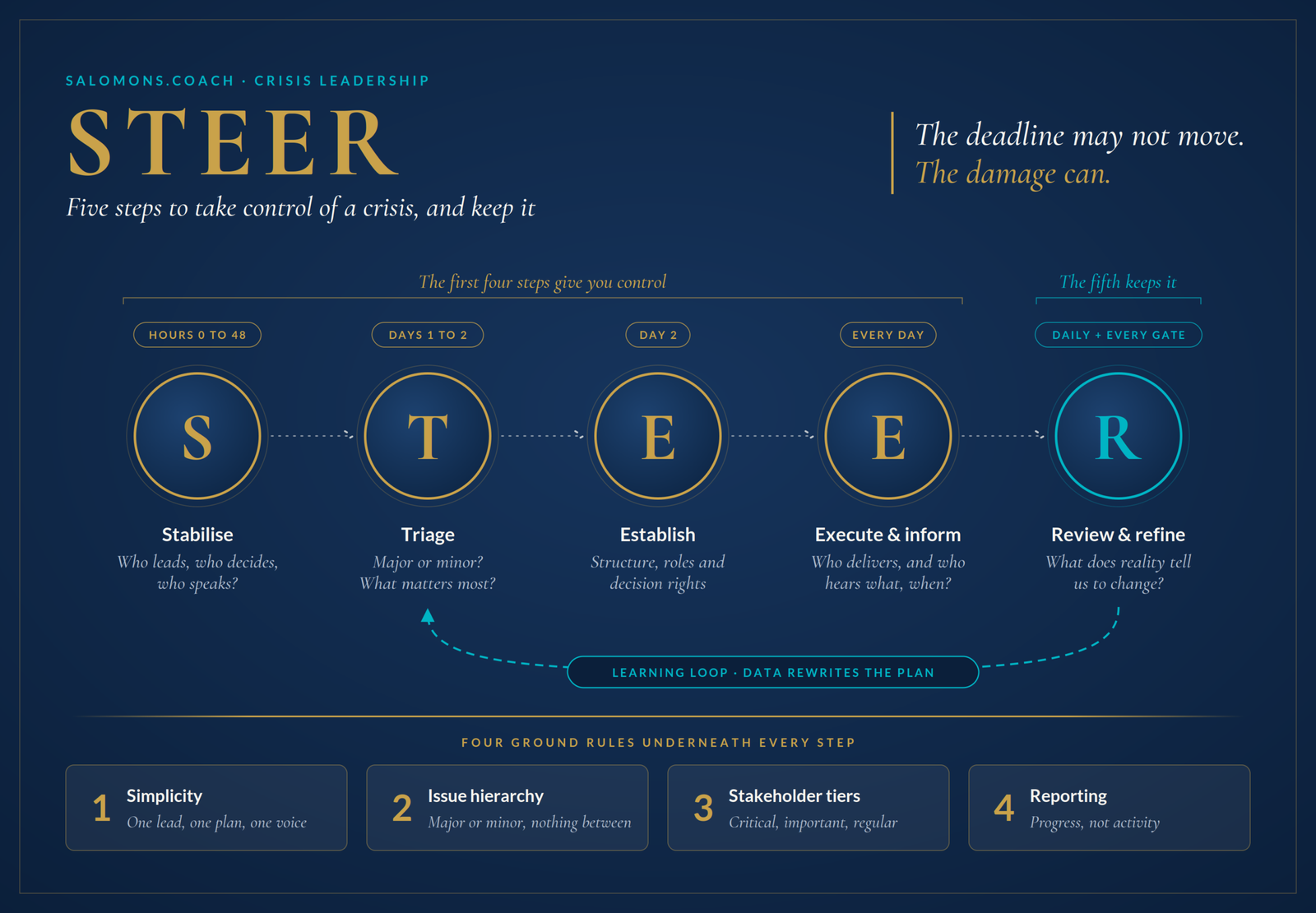
What works sits in between: a light structure that gives control, and a learning loop that keeps the structure honest. I use a five-step approach for this, which I call STEER.
The first four steps give you control. The fifth keeps it.
Four rules that sit underneath everything
Before any step, there are four rules. They are not a phase. They run through every decision, every meeting and every message. Break one and the framework slowly falls apart, usually without anyone noticing until day ten.
Keep it as simple as possible. Complexity is the natural enemy of speed. One accountable sponsor, one program lead, one plan, one dashboard, one voice per audience. If you cannot explain the crisis structure on a single page, it is too complicated.
Separate major issues from minor ones. In a crisis everything feels urgent, which is exactly why nothing gets done. A major issue threatens the outcome. A minor issue slows the work. Major issues get leadership attention today. Minor issues get an owner and a date, and stay out of the steering meeting.
Split stakeholders into critical, important and regular. Treat everyone the same and the critical few get too little while the many get too much. Each tier gets its own cadence, its own channel and its own voice.
Report progress, not activity. A crisis generates enormous activity. A board needs three answers: are we on track, what has changed, and what do you need from us? Same measures, same format, same moment, every day.
There is a paradox in the first rule worth naming. Karl Weick and Kathleen Sutcliffe, who studied organisations that cannot afford to fail, found that the best of them are reluctant to simplify how they interpret events. That sounds like the opposite of Rule 1. It is not. Simplify the structure. Never simplify the facts.
Stabilise: take charge before you take action
The first job is not to solve the crisis. It is to stop it from spreading.
In the first 48 hours, the program manager secures a written mandate: scope, authority, resources, decision rights, and an accountable sponsor at board level. A crisis role without a written mandate is a scapegoat role. This matters twice as much for someone who is new, because the organisation’s memory of who dropped the ball is short and selective.
The core team is named and released from their day jobs, in writing, by the sponsor. Part-time crisis roles fail. The specialists who protect the organisation’s position, usually legal, sometimes finance or compliance, join on day one rather than being asked to review the result on day twelve. External communication is frozen to one voice, a holding statement is ready, and documents are preserved.
Then comes the step most people skip: document the baseline. What was done before you arrived, what was not, what you know and what you do not. Factual and neutral, shared with the sponsor. Not to blame the past, but to anchor the future.
The test at the end of Stabilise is simple. Can everyone involved answer, in one sentence, who leads, who decides and who speaks?
Triage: separate the major from the minor
Crisis analysis is not about knowing everything. It is about knowing the few things that decide the outcome.
Start with the obligation itself. Not the rumour, the source. Which contract, regulation or promise, which date, and what exactly counts as “done”? Then look at the consequence of a miss, in money, rights, reputation and people, with a worst, a likely and a best case. From those two answers you can define the most useful concept in any crisis: the minimum defensible outcome. The smallest result that still meets the obligation, or clearly limits the damage.
Then find where the exposure sits. In almost every crisis I have worked on, a small group of customers, suppliers or systems carries most of the risk. Find them in the first two days and work on them first.
Every issue that surfaces gets one of two labels, major or minor. Two levels are enough. A third level invites debate about the level instead of the issue. When the team disagrees, one question settles it: if this stays unsolved, do we miss the minimum defensible outcome? If the answer is yes, it is major.
Finally, triage produces three parallel tracks. The first aims to comply by the deadline. The second protects the organisation now, in case the first only partly lands: negotiating early, documenting good faith, reducing the exposure. The third keeps the business running with interim arrangements. The most expensive mistake in crisis management is starting the second and third tracks after the first has already failed.
The deadline may not move. The damage can.
Establish: decide who decides, before anyone has to
Structure is not bureaucracy. In a crisis, structure is what allows people to act without asking permission.
At the organisation level, three layers are enough. A small crisis steering team, chaired by the sponsor, decides on scope, trade-offs, mandates and external messages. A war room, led by the program manager, runs the plan and clears blockers. Workstreams deliver, each with one lead and one clear output. At program level, workstreams follow the outcome, not the org chart: the core obligation, the external parties, operational readiness, exposure and finance, communication. More than six, and the program lead is coordinating instead of leading.
Decision rights are agreed in advance. Workstream leads decide within pre-approved templates and positions. The program lead decides trade-offs between workstreams. The sponsor decides deviations, mandates, budget and external dates. The board decides anything above the agreed worst case. A blocker that is not solved within two hours moves one level up. A decision that is not taken within 24 hours goes to the sponsor. Speed is designed, not demanded.
On the timeline, four or five fixed decision gates: strategy, mandate, midpoint, readiness, go or no-go. At each gate the steering team decides explicitly and writes down why. That decision log becomes the best evidence of good faith you will ever have, and the best source of learning.
Execute and inform: rhythm, tiers and one honest page
Execution rarely fails on effort. It fails on rhythm. Communication rarely fails on content. It fails on timing.
The rhythm is fixed and short. A fifteen-minute stand-up at the start of the day for targets, blockers and owners. A thirty-minute steering meeting at the end of the day, for decisions only. Nothing else is mandatory. Each workstream has a daily target that everyone can see. And one cultural rule matters more than any tool: red is good. Reporting a problem early is rewarded. Hiding it is the only real failure.
For stakeholders, the three tiers translate into a cadence.
| Tier | Who | What they need | Cadence |
|---|---|---|---|
| Critical | Sponsor, board, the party the obligation is owed to, key specialists | Truth, options, decisions | Daily or at every gate, in person |
| Important | Key customers and suppliers, customer-facing teams, supervisory board, works council | What changes for them and what they must do | Weekly and at key moments, personal first, then in writing |
| Regular | Wider staff, other parties with an interest | Awareness and what to say if asked | At the start and at the close, in writing |
The tiers are not fixed. A regular stakeholder who becomes a blocker moves up the same day. A critical stakeholder whose issue is solved moves down. The sequence matters as much as the message: critical first, then important, then regular. Nobody critical should hear the news from someone else.
Progress reporting fits on one page, in the same format, at the same time, every day. Status against the minimum defensible outcome, with the trend since yesterday. Two or three numbers that matter, planned against actual. Major issues only, each with an owner and a decision date. The decisions needed from the steering team or the board. And a forecast of what will be delivered at the deadline, stated honestly. The forecast is the line that matters most. A board can handle bad news. It cannot handle surprises.
Review and refine: let reality rewrite the plan
Every crisis plan is a hypothesis, and reality tests it every day. The question is whether anyone is listening.
Most organisations learn after the crisis, in an evaluation nobody reads. By then the lessons arrive too late for the people who paid for them. STEER builds learning into the crisis itself, on three rhythms.
Daily, the last five minutes of the steering meeting are reserved for two questions. What did the data tell us today that we did not expect? What do we change tomorrow because of it? This is John Boyd’s OODA loop (observe, orient, decide, act) in its simplest form. The team that learns faster than the crisis moves stays ahead of it.
At every gate, the core team runs a short after-action review, borrowed from the US Army. What did we expect to happen? What actually happened? Why was there a difference? What do we keep and what do we change? Thirty minutes, facts on the table, no blame.
In between, the data itself signals when the way of working needs to change. Opinions are not required.
| Signal in the data | What it usually means | Adjustment |
|---|---|---|
| Escalations pile up at the sponsor | Decision rights are too narrow | Widen the mandate of the program or workstream leads |
| Actual progress lags the plan two days in a row | Triage was too optimistic | Re-triage, shrink the scope, strengthen the fall-back track |
| Stakeholders keep asking the same questions | Cadence or channel is wrong | Move them up a tier or send a fixed update |
| Steering meetings overrun | Minor issues are on the agenda | Enforce the hierarchy, reduce attendance |
| Issues keep moving from minor to major | The criteria are unclear | Sharpen the one-question test |
| The forecast swings between reports | Poor data or hidden problems | Go and look, check the source yourself |
The program lead owns the way of working, and changes are announced at the stand-up rather than negotiated in corridors. Change one or two things at a time, or you will never know what worked. Keep a learning log of what you observed, what you changed and what the effect was. Stability of rhythm beats perfection of rhythm. Refine, do not redesign.
Arjen Boin and his colleagues describe learning as one of the core tasks of crisis leadership, and one that is easily neglected once the pressure is off. The learning log is what prevents that. It becomes the backbone of the final review, and the start of a crisis playbook the organisation did not have before.
What changed for Sanne
Sanne did not like the second conversation we had. Her instinct was to go back to the COO with a full plan that showed everything live in fourteen days. “If I tell him it will not all be done, he will think I am the problem,” she said.
That fear is understandable, and it is how new leaders become the face of a failure they did not create. We spent most of the session on one question: what does the COO need to know on day two that he does not know yet?
On day two she presented the baseline, the minimum defensible outcome and the three tracks. The COO pushed back hard for ten minutes. Then he took over the conversation with the counterparty himself, which is exactly where it belonged. Legal sat in the war room from that day on. The customers and suppliers that carried most of the exposure were signed first, the rest were covered by interim arrangements and a phased plan agreed well before the deadline.
Not everything was live on day fourteen. The damage was a fraction of what it could have been, and Sanne came out of it as the person who brought control rather than the person who missed the date.
Steering, not rescuing
A crisis tempts leaders into one of two roles: the hero who fixes everything, or the messenger who reports what went wrong. Both are traps. The program manager’s real work is to steer. Create control with as little structure as possible, separate what matters from what is noise, give each stakeholder what they need when they need it, report progress honestly, and let reality correct the plan every day.
Readers who know the 4R Model™ will recognise its rhythm here. A short, honest Reflect on the real situation. A hard Reset of expectations. Re-Align of board and team around what is actually achievable. And the Rise that follows from visible, steady leadership under pressure. In a crisis, those four moves are compressed into days rather than months. They still work.
Questions to reflect on
If a crisis landed on your desk tomorrow, who would decide, who would speak, and who would carry the blame?
Which of your stakeholders are critical, and do they know that you know it?
When did your organisation last change its way of working because of data rather than opinion?
What did your organisation learn from its last crisis, and where is that written down?
Verder lezen
Boin, A., ‘t Hart, P., Stern, E. and Sundelius, B., The Politics of Crisis Management: Public Leadership under Pressure. Cambridge University Press.
Weick, K. E. and Sutcliffe, K. M., Managing the Unexpected: Sustained Performance in a Complex World. Wiley.
Boyd, J., the OODA loop (observe, orient, decide, act), and the US Army’s After Action Review practice.
Related on Salomons.Coach: Power Deafens: Why Leaders Stop Hearing the Truth, on why the people at the top are often the last to hear that the plan is not working.
Sanne is a composite character based on several coaching engagements. Names, organisations and details have been changed to protect client confidentiality.

Dit vind je misschien ook leuk

De meeste leidinggevende teams missen dialoog
Het is niet de werkdruk. Stop met het de werkdruk te noemen.
