Uw Persoonlijk Stress Coping Profiel: Druk Omzetten in Inzicht
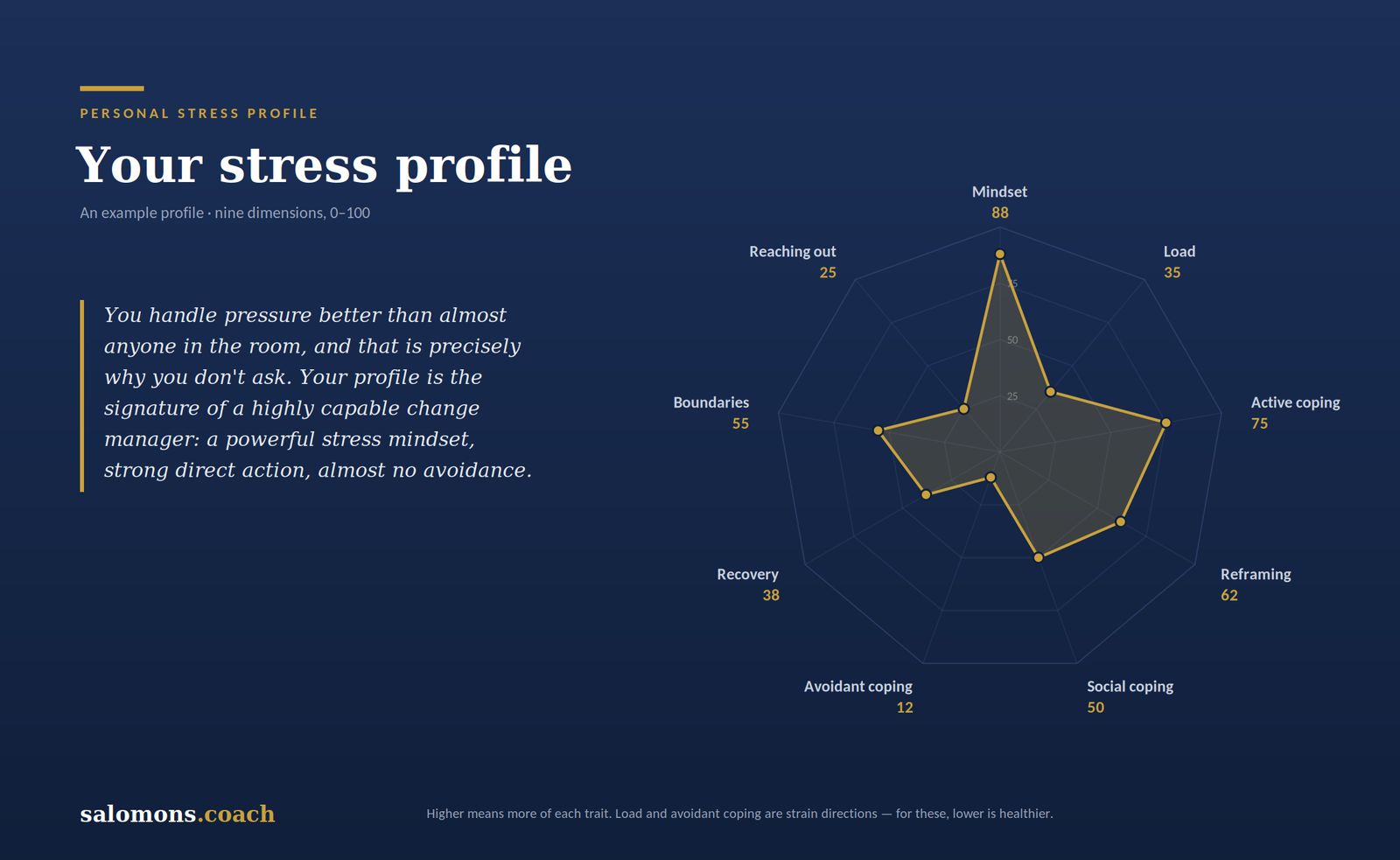
Jouw Persoonlijk Stresshanteringsprofiel
Druk omzetten in inzicht – en inzicht in bewuster, duurzamer kiezen.
Door Jan K. Salomons · Salomons.Coach · Executive Coaching · Leiderschapsontwikkeling · Stressbestendigheid
Samenvatting
Stress wordt vaak besproken alsof het een enkele, gemakkelijk te identificeren aandoening is. In werkelijkheid verschillen mensen aanzienlijk in wat druk veroorzaakt, hoe ze dit interpreteren, welke coping-reacties ze gebruiken en hoe effectief ze herstellen. Persoonlijk Stress Coping Profiel™ biedt een gestructureerde spiegel van deze patronen.
Het profiel is geen klinische diagnose en wijst mensen geen vaste persoonlijkheidscategorieën toe. Het creëert een praktisch startpunt voor reflectie, coaching en ontwikkeling door de huidige druk, copinggewoonten, veerkrachtbronnen en herstelpatronen zichtbaarder te maken.
Stress is bekend. Onze eigen patronen zijn vaak minder zichtbaar.
De meeste ervaren professionals weten hoe stress voelt. Ze herkennen de mentale rusteloosheid, verminderde concentratie, kortere geduld, fysieke vermoeidheid of het aanhoudende gevoel dat er nooit genoeg tijd is. Toch is het herkennen van de druk niet hetzelfde als begrijpen hoe het werkt.
Mensen kunnen vergelijkbare eisen ervaren en heel verschillend reageren. De ene persoon wordt zeer gefocust en besluitvaardig, terwijl de ander begint te twijfelen of zich terugtrekt. Sommige mensen zoeken al vroeg steun; anderen werken harder en worden steeds meer geïsoleerd. Sommigen herstellen vanzelf als een veeleisende periode voorbij is, terwijl anderen mentaal betrokken blijven lang nadat de directe druk is verdwenen.
Deze verschillen zijn niet simpelweg een kwestie van sterk of zwak zijn. Ze komen voort uit een combinatie van werkdruk, persoonlijke omstandigheden, overtuigingen over stress, gevestigde copingmechanismen, beschikbare middelen en de omgeving waarin iemand werkt.
Waarom een persoonlijk stresscopingprofiel opstellen?
Stress wordt vaak pas zichtbaar nadat het al een impact heeft op prestaties, relaties, gezondheid of zelfvertrouwen. Vóór dat punt worden de vroege signalen gemakkelijk weggewuifd. Een veeleisende week wordt een veeleisende maand. Tijdelijke vermoeidheid wordt de nieuwe norm. Langer werken lijkt het directe probleem op te lossen, zelfs als het geleidelijk de capaciteit om te denken, te herstellen en weloverwogen beslissingen te nemen vermindert.
Reflectie kan dat patroon doorbreken, maar reflectie is moeilijk als het abstract blijft. Simpelweg vragen: “Hoe gestrest ben ik?” levert zelden voldoende inzicht op om gedrag te veranderen. Een gestructureerd profiel helpt de ervaring op te splitsen in nuttigere vragen: Wat veroorzaakt druk? Hoe interpreteer ik die druk? Wat doe ik als de eisen toenemen? Welke reacties helpen me, en welke bieden mogelijk korte-termijn verlichting, terwijl ze op langere termijn risico's creëren?
Het doel van het profiel
Het Personal Stress Coping Profile™ creëert een gestructureerd overzicht van uw huidige ervaren druk en de manieren waarop u daarop reageert. Het is ontworpen om groter zelfinzicht, constructieve dialoog en weloverwogen keuzes te ondersteunen – niet om een complex persoon te reduceren tot een score.
Wat verkent het profiel?
Het profiel onderzoekt verschillende onderling verbonden dimensies. Geen enkele mag geïsoleerd worden geïnterpreteerd. Samen bieden ze een rijker beeld van hoe druk momenteel wordt ervaren en beheerd.
Huidige druk
Het profiel begint met de eisen waar u momenteel mee te maken heeft. Dit kunnen werkdruk, deadlines, conflicterende prioriteiten, onzekerheid, interpersoonlijke spanningen of belangrijke omstandigheden buiten het werk zijn. Het doel is niet om uw situatie met die van iemand anders te vergelijken, maar om te begrijpen hoe veeleisend het momenteel voor u aanvoelt.
Stress overtuigingen en mindset
Wat we geloven over stress beïnvloedt hoe we erop reageren. Druk kan worden geïnterpreteerd als een uitdaging, een bedreiging, een teken van persoonlijk falen of simpelweg een onvermijdelijk onderdeel van verantwoordelijkheid. Deze overtuigingen vormen gedrag, inclusief of we hulp zoeken, volhouden, ons terugtrekken of proberen de controle terug te krijgen door nog harder te werken.
Copingsstrategieën
Omgaan beschrijft de acties en mentale strategieën die we gebruiken om met eisen om te gaan. Dit kan probleemoplossing, planning, steun zoeken, de situatie herformuleren, vermijding, afleiding of emotionele onderdrukking omvatten. Een copingreactie is niet automatisch goed of slecht; de waarde ervan hangt af van de situatie en van de langetermijngevolgen ervan.
Veerkrachtmiddelen
Veerkracht wordt ondersteund door meer dan alleen vastberadenheid. Persoonlijke hulpmiddelen kunnen zelfvertrouwen, autonomie, ervaring, een gevoel van zingeving en het vermogen om gebeurtenissen in perspectief te plaatsen omvatten. Externe hulpmiddelen omvatten ondersteunende relaties, duidelijke rolverwachtingen, toegang tot expertise en het praktische vermogen om hulp te vragen.
Grenzen en capaciteit
Veel capabele professionals reageren op toenemende vraag door hun werkdag te verlengen, hersteltijd te verminderen en extra verantwoordelijkheden te aanvaarden. Dit kan tijdelijk werken, maar kan verbergen dat de vraag de duurzame capaciteit heeft overschreden. Het profiel helpt bij het onderzoeken van de manier waarop grenzen worden herkend, gecommuniceerd en beschermd.
Herstel en leren
Herstel is niet simpelweg de afwezigheid van werk. Het omvat het creëren van voldoende afstand voor lichaam en geest om energie en perspectief te herstellen. Het profiel onderzoekt ook of veeleisende periodes leiden tot leren en veranderd gedrag, of dat dezelfde patronen zich herhaaldelijk herhalen.
Wat het profiel is - en wat het niet is
Verantwoord gebruik vereist duidelijke grenzen. Een reflectief coachingsinstrument moet inzicht ondersteunen zonder te pretenderen een medische of psychologische diagnose te geven.
Het profiel is
- Een gestructureerde spiegel van huidige patronen.
- Een startpunt voor reflectie en coaching.
- Een manier om druk en omgaan met druk bespreekbaarder te maken.
- Een middel om sterktes en ontwikkelpunten te identificeren.
- Een momentopname die kan veranderen naarmate de omstandigheden veranderen.
Het profiel is niet
- Een medische of klinische diagnose.
- Een persoonlijkheidstest of een permanent label.
- Een oordeel over of iemand veerkrachtig genoeg is.
- Een voorspelling dat burn-out wel of niet zal optreden.
- Een vervanging voor professionele medische of psychologische zorg.
Van antwoorden naar betekenisvolle reflectie
Het invullen van een vragenlijst is niet het eindresultaat. De waarde ervan ligt in de kwaliteit van de reflectie en het gesprek dat daarop volgt. Het proces combineert derhalve gestructureerde input met professionele interpretatie en praktische dialoog.
Vul het profiel aan
U beantwoordt een gestructureerde reeks vragen over huidige druk, stressovertuigingen, copinggedrag, veerkrachtbronnen, grenzen en herstel. De vragen zijn ontworpen om eerlijke reflectie aan te moedigen in plaats van een wenselijke score te produceren.
Ontvang een persoonlijk overzicht
Uw antwoorden worden vertaald naar een toegankelijk profiel dat huidige patronen, relatieve sterke punten en gebieden benadrukt die mogelijk meer aandacht verdienen. Het profiel moet worden gelezen als een momentopname en als bron van vragen, niet als een oordeel.
Verken de betekenis
Tijdens een coachingsgesprek worden de resultaten geïnterpreteerd in de context van uw rol, werkomgeving, persoonlijke omstandigheden en doelstellingen. Dit voorkomt dat geïsoleerde scores worden behandeld alsof ze het hele verhaal vertellen.
Kies gerichte acties
Het proces wordt afgesloten met een klein aantal realistische prioriteiten. Deze kunnen betrekking hebben op keuzes met betrekking tot de werkdruk, herstel, communicatie, ondersteuning, grenzen, rolduidelijkheid of specifieke coping-strategieën. Het doel is niet om alles te veranderen, maar om actie te ondernemen waar de grootste impact gemaakt kan worden.
Individueel inzicht is slechts het begin
Een persoonlijk profiel kan je eigen patronen zichtbaar maken, maar het kan de omgeving waarin die patronen opereren niet volledig verklaren. Het aanpassingsvermogen wordt ook beïnvloed door werkdruk, rolduidelijkheid, leiderschapsgedrag, teamrelaties en of praktische ondersteuning beschikbaar komt wanneer de druk toeneemt.
Dit is waarom individuele en collectieve coping niet als concurrerende verklaringen behandeld mogen worden. Individuen blijven verantwoordelijk voor het herkennen van hun patronen, eerlijke communicatie en het maken van verantwoorde keuzes. Teams en leiders beïnvloeden of die keuzes worden aangemoedigd, ondersteund en omgezet in zinvolle actie.
Persoonlijk Stress Coping Profiel™
Creëert inzicht in de huidige druk, copingpatronen, veerkrachtbronnen, grenzen en herstel van een individu.
Team Stress Coping & Resilience Profile™
Combineert geselecteerde, geanonimiseerde input om een team te helpen begrijpen hoe druk, coping-middelen en veerkrachtcondities verdeeld zijn over de leden.
Het Collectieve Coping Framework™
Biedt zes teamcapaciteiten waarmee leiders en teams gedeeld bewustzijn, open communicatie, wederzijdse ondersteuning, aanpassingsvermogen, constructieve uitdaging en collectief leren kunnen versterken.
Vragen die je jezelf moet stellen
U heeft geen formele beoordeling nodig om te beginnen met reflecteren. De volgende vragen kunnen een eerste indicatie geven van waar meer aandacht nuttig kan zijn.
Een persoonlijke stress- en coping-check-in
- Welke bronnen van druk hebben momenteel de grootste impact op mijn energie en aandacht?
- Welke gedragsveranderingen duiden er meestal op dat mijn capaciteit beperkt wordt?
- Welke copingmechanismen helpen mij om het onderliggende probleem aan te pakken?
- Welke gewoonten bieden tijdelijke verlichting maar kunnen op langere termijn risico's creëren?
- Welke aannames maken het voor mij moeilijk om hulp te vragen of verwachtingen aan te passen?
- Welke verantwoordelijkheden draag ik omdat ze echt van mij zijn— en welke zijn er bijgekomen omdat ik betrouwbaar ben?
- Wat momenteel mijn herstel ondersteunt, en wat het herhaaldelijk onderbreekt?
- Wat is één praktische verandering die onnodige druk zou verminderen zonder de essentiële prestaties te compromitteren?
Een spiegel, geen etiket
Het doel van het Personal Stress Coping Profile™ is niet om mensen te classificeren als veerkrachtig of kwetsbaar. Menselijke reacties op stress zijn dynamischer dan dat. Dezelfde persoon kan in de ene omgeving effectief omgaan met stress en in de andere moeite hebben, afhankelijk van de eisen, beschikbare middelen, persoonlijke omstandigheden en de ondersteuning die hen omringt.
Een nuttig profiel werkt dus als een spiegel. Het helpt patronen zichtbaar te maken, creëert taal voor een eerlijker gesprek en ondersteunt beslissingen die anders misschien worden uitgesteld totdat de druk al schadelijk is geworden.
Stress kan niet altijd voorkomen worden en moeilijke periodes maken deel uit van een professioneel en persoonlijk leven. Meer inzicht kan er echter voor zorgen dat onze reacties minder automatisch en bewuster worden. Het kan ons helpen herkennen wanneer we moeten doorzetten, wanneer we ons moeten aanpassen, wanneer we steun moeten zoeken en wanneer de omstandigheden om ons heen moeten veranderen.
Ontdek de Collectieve Coping Serie
Zou meer inzicht u helpen effectiever te werken onder druk?
Het Personal Stress Coping Profile™ kan worden gebruikt als onderdeel van een individueel coachingstraject of als vertrouwelijke voorbereiding op een gefaciliteerd groepsprogramma. Het biedt een gestructureerd startpunt voor het begrijpen van huidige patronen en het identificeren van een gerichte set praktische ontwikkelingsprioriteiten.
Waar het profiel binnen een team wordt gebruikt, blijven individuele resultaten vertrouwelijk. Alleen geselecteerde en geanonimiseerde informatie wordt gecombineerd om het Team Stress Coping & Resilience Profile™ te creëren.
Een vertrouwelijke gesprek beginnen- Delen:

Dit vind je misschien ook leuk
Wat gezien wordt, wordt herhaald – Brandweer versus Preventers
- 26 september 2026
- door salomons.coach
- in Blog
Vijf stappen om onmiddellijk controle over een crisis te krijgen
De meeste leidinggevende teams missen dialoog