A leadership program designed to help teams lead with clarity, focus, courage, and accountability — as one team.
Location
Arnhem
Audience
Hub Leadership Team
Format
Workshop series
Facilitator
Jan Salomons
Why this program
Performance demands keep rising. Leadership capacity has to rise with them.
Every operation reaches a point where what got you here won't get you there. The pressure to deliver keeps increasing — faster decisions, tighter margins, more complex stakeholder environments, workforces that want more meaning and more autonomy than ever before. The instinct is to tighten controls, add process, and demand more from the team.
That instinct is not wrong — but on its own, it breaks teams. Control without trust produces compliance, not ownership. Process without judgement produces rigidity, not resilience. Pressure without clarity produces burnout, not performance.
This program was built for leaders at the FedEx QAR Hub who are being asked to deliver all three at once: stronger performance, a healthier culture, and a genuine capacity for change — without losing the operational discipline that makes the business work.
It does not treat culture and performance as competing priorities. It treats them as one system.
The three mandates
What participants build during the program.
Three mandates that reinforce one another. None of them work alone.
01
A transformation mindset
Embracing change as an opportunity, not a threat — and driving it with energy and purpose. This mandate is about the inner shift before the outer one. You cannot lead a team through change you have not yet accepted yourself. Participants practice noticing their own resistance, reframing uncertainty as signal rather than noise, and communicating change in ways that invite commitment rather than compliance.
02
Strong performance management
Setting clear expectations, holding yourself and your team accountable, and celebrating what works. Performance management is often misunderstood as a control mechanism. In this program, it is taught as a leadership discipline: the ability to be specific about what good looks like, to have honest conversations when the bar is not met, and to recognise effort and outcome distinctly. It is how ownership becomes visible.
03
Courageous leadership
Leading with integrity, making decisions, and having the conversations that matter. Courage is not the absence of doubt — it is the willingness to act in its presence. Participants work on the specific conversations they have been avoiding, the decisions they have been deferring, and the signals they send when they do and do not speak up. This is the hardest of the three because it is the most visible.
Culture is not a separate initiative from performance. It is the system by which performance actually happens.
Salomons.Coach · Program Principle
Program structure
How the program is delivered.
A multi-workshop series delivered to the Hub Leadership Team — designed so each session builds on the last, with deliberate space between sessions for leaders to apply what they have learned in their own context.
Format
Interactive workshops with facilitated practice, not lectures. Participants work on real situations from their own context.
Audience
The Hub Leadership Team — working as one team, with shared language and aligned expectations.
Duration
A multi-workshop series of five workshops across six days, spaced to allow practice between sessions.
Delivery
Off-site in the surroundings of Arnhem, facilitated personally by Jan Salomons.
Emphasis
Implementation discipline. What participants learn on day one must be visible on the floor by day two.
The five workshops
A leadership journey — structured, sequential, cumulative.
Each workshop builds deliberately on the last. The arc moves from truth to sustainability — naming reality before translating it into behaviour, designing the daily system before reinforcing it, and only then asking how to make it last.
Role clarity — Managers vs. Supervisors vs. Process Coordinators
Designing the Supervisor Integration Game Plan
Outputs
One aligned Operating Model — behavioural and structural
Leadership rhythm defined
Supervisor integration defined
A3: Supervisor Integration Game Plan
04
Behaviour, Ownership & Reinforcement
From system → consistent behaviour
Topics
Managers as behaviour amplifiers — or blockers
Ownership vs. escalation behaviour
Making behaviour visible — what do we see daily?
Leadership interventions in real situations
Feedback culture — direct, operational, fast
Alignment on the non-negotiables
Breaking old patterns (firefighting, avoidance)
Outputs
Clear behavioural expectations
Reinforcement mechanisms defined
Ownership embedded in daily leadership
Leadership consistency increased
05
Performance, Sustainability & Scaling
From improvement → sustainable results
Topics
Review of progress across all themes (trend analysis)
What actually improved in performance — data-driven
Sustainability of new behaviours
Scaling across shifts and departments
Embedding into systems — HR, performance management, governance
Leadership legacy: what stays when pressure increases
Final commitments and forward roadmap
Outputs
Measurable progress overview
Sustainability plan
Embedded leadership model
Clear forward commitments
Measurement · proof of movement
From self-reported confidence to observed capability.
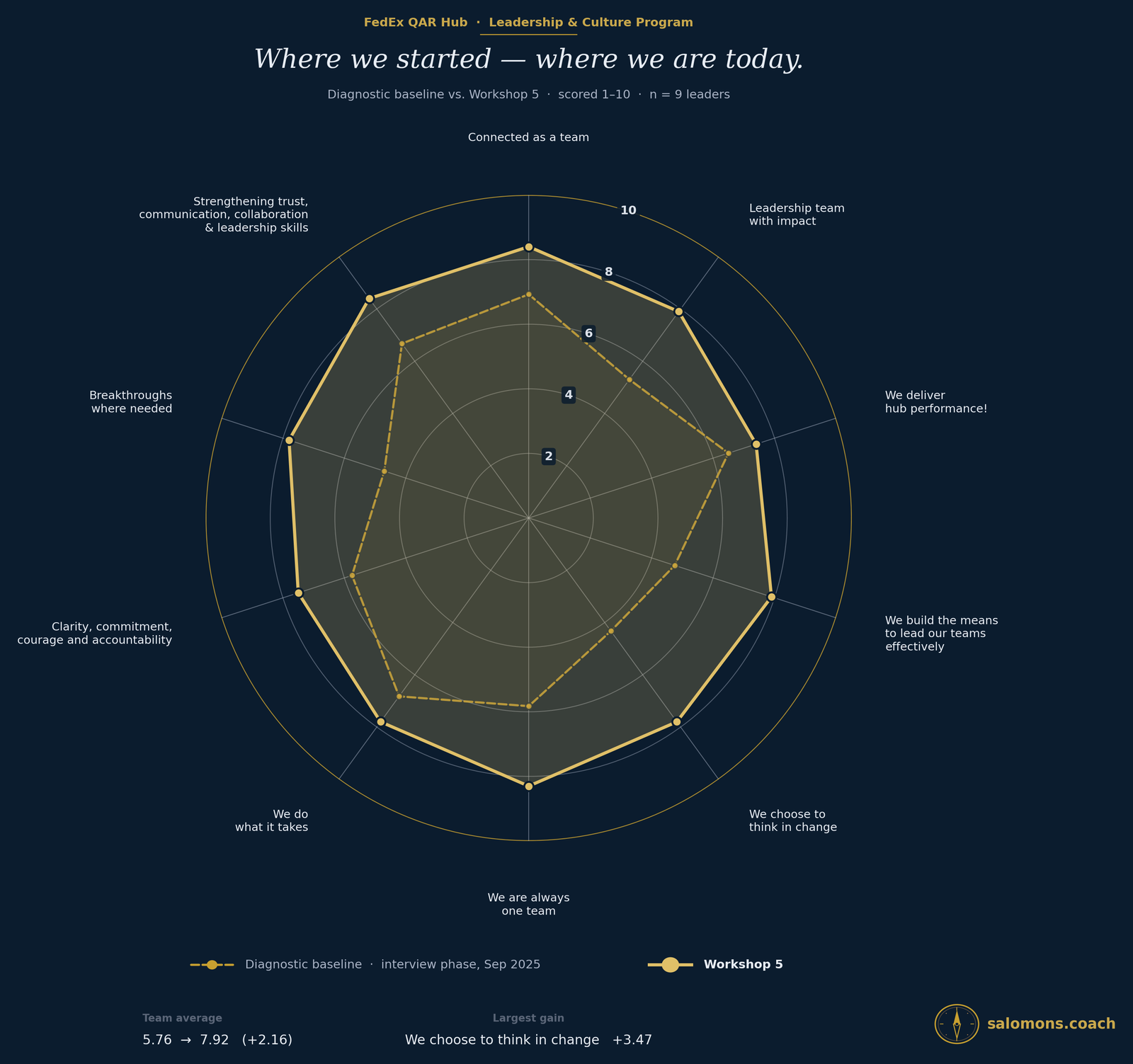
The program does not rely on participant enthusiasm. It measures movement. Before Workshop 1 begins, each member of the Hub Leadership Team is interviewed individually against the ten program goals — producing a diagnostic baseline grounded in behavioural observation, not self-report. After each workshop, the team scores itself again. The gap between those two lines is the story.
Team average5.76 → 7.92A +2.16 point gain on a 10-point scale across ten leadership goals — measured from the pre-program diagnostic to the final workshop.
Largest gain+3.47"We choose to think in change." The weakest capability at diagnosis became one of the strongest — confirming the transformation mindset mandate has landed in practice, not just in language.
Capabilities built10 / 10Every goal improved. Three moved by more than three full points. No regressions. The journey is asymmetric — and that asymmetry is itself a finding.
A finding from Workshop 5
The most telling movement in the final workshop was not an increase — it was a decision to score lower. The team revised its own rating on "We deliver hub performance!" downward, even though the underlying trend is upward and targets are now in sight. Their reasoning: good enough is not yet good enough.
That willingness to be more honest with themselves, rather than claim credit for progress, is itself the shift the program set out to produce. Senior management read the lower score the same way — not as a setback, but as a signal of the increased ownership the team will need to accomplish a service performance breakthrough. Operational excellence became the team's own agenda, not a directive from above.
It is the clearest evidence on this page that culture has become the system by which performance actually happens.
Diagnostic baseline n = 9 leaders, interview phase, September 2025. Workshop 5 self-assessment n = 9 leaders, final workshop. Scores are team averages on a 1–10 scale; the diagnostic is grounded in interview-based behavioural observation, not self-report, which is why it is a more honest reference point than a first-day survey.
Outcomes
What participants leave with — stated as what leaders can do, not what they have heard about.
Name the change they are leading — in their own words, in a way their team can repeat back.
Set a clear performance expectation and hold it, without collapsing into either avoidance or aggression.
Have a difficult conversation they have been avoiding — and do it in a way that strengthens the relationship.
Distinguish between a decision that is theirs to make and one that belongs to the team, and communicate each clearly.
Recognise the signals they send as a leader — especially the ones they are not aware of.
Operate as one Hub Leadership Team — with shared language, aligned expectations, and visible follow-through.
About the facilitator
Jan Salomons
Founder · Salomons.Coach
Based in Arnhem, Jan works with leadership teams on transformation, performance, and culture — drawing on a practice grounded in HBR, INSEAD, MIT Sloan Management Review, and the work of Karl Weick, Daniel Pink, Clayton Christensen, and Argyris & Schön.
His approach is deliberately people-centered and systems-oriented: he surfaces the tensions organisations prefer to leave unspoken — ownership versus structure, empowerment versus control, learning versus zero-defect logic — and helps leadership teams work through them rather than around them.
Jan publishes the bi-weekly newsletter The Leadership Compass and contributes to the broader leadership conversation as a member of the HBR Advisory Council for Leadership. His current book, Leading in a VUCA World, is in writing.
Next steps
Two paths from here.
If you completed the program
Keep the compass close.
Your development does not end with the certificate. Subscribe to The Leadership Compass — a bi-weekly newsletter with concrete tools and frameworks to keep applying what you built. You can also reach out directly with situations you want a second perspective on.
If you are responsible for leadership development, transformation, or operations — at another part of FedEx or at a different organisation entirely — and you are facing the same pressure to deliver performance, culture, and change at once, this program can be adapted. The mandates travel; the material does not.